For Australian businesses experiencing supply chain volatility and disruptions, visit the Go Global Toolkit for the latest updates and support available.
A handwritten sign on a chalkboard may be an unusual way for an Australian business to find their first US partner. For Australian cultured butter producer Pepe Saya, it turned out to be the perfect way to connect with partners that value hand-crafting, sustainability and uncompromising quality.
The chalked message at the 2023 New York Fancy Food Show piqued the interest of Brother Daniel from Lancaster County, who helps Amish farmers to get their milk to market.
Pepe Saya Co-founder and CEO, Melissa Altman, told him Pepe Saya was looking for someone in the US who could make butter according to its recipe. Brother Daniel said, ‘We’ve been making butter for 300 years in Pennsylvania. Let us make the butter right on the farm.’
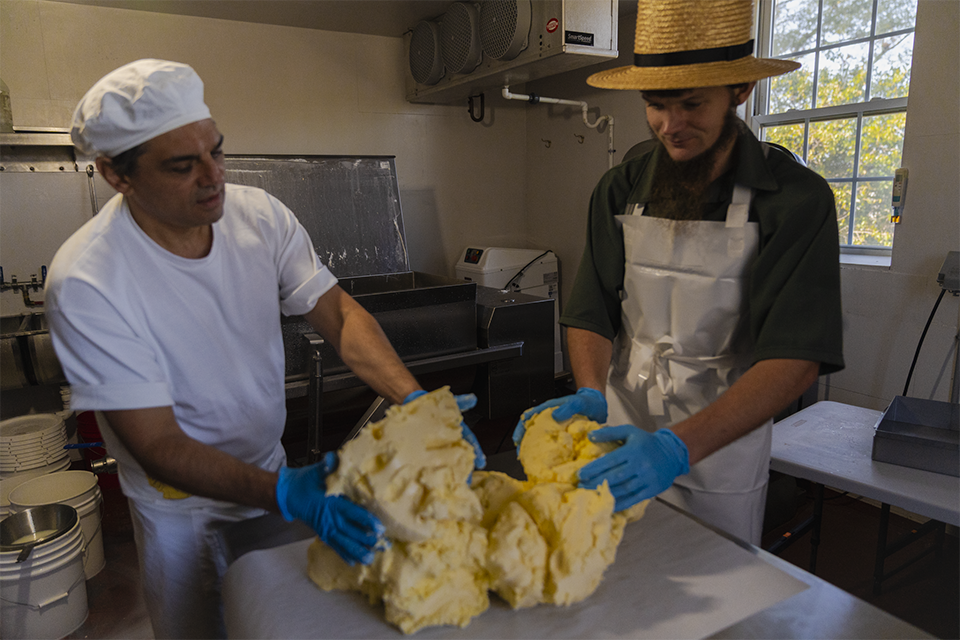
Pepe Saya’s US buttery was established on an Amish farm the following year. Today, it supplies Pepe Saya’s signature batch-churned, handcrafted cultured butter to around 1,000 retailers and food service businesses across the US.
Meeting a demand for flavoursome, handmade butter
Exporting has been a way for Pepe Saya to maintain its quality standards and values, explains Georgia Somerville, Pepe Saya’s Head of Growth and Communications.
‘Australia is a small market and there is a limit to how much we can sell here without reducing our quality to meet a lower price point,’ she explains.
In 2022, Pepe Saya landed an opportunity to export its butter to Central Market in Texas and test the market.
‘Austrade supported us by spreading the word about Pepe Saya launching in Texas, sharing our butter at tables for their events, offering support to our wholesale customers and helping us with logistics and administrative questions,’ says Somerville.
‘We knew after a few months that this was a market where we could grow.’
At US food events, Pepe Saya was surprised to see how many people wanted to check the ingredients list and ask questions. Australian customers tend to take grass-fed dairy for granted, but that has been a key selling point for the US market.
‘People love the story and want to understand the process, but what really sells the product is the taste,’ says Somerville. ‘It’s all well and good telling them it’s a beautiful butter, but they need to try it.’
‘Where there are cows, we export the brand’
In markets such as the US with an established dairy industry, Pepe Saya aims to produce locally. However, finding partners willing to take the time to produce an artisanal cultured butter that requires time and hand-crafting can be a challenge.
Not so the Amish community. Pierre Issa – Co-founder and the Pepe behind Pepe Saya – travelled to Lancaster County to meet the Amish farmers and secure the blessing of the community’s elders to proceed with the US buttery. He returned and spent 3 months living in the community to show the producers how to make butter according to Pepe Saya’s recipe.
Pierre Issa shows an Amish producer how to make butter according to Pepe Saya’s recipe.
For the Amish, the buttery offers sustainable employment within the community. A collective of Amish dairy farms now supplies around 3,000 litres of cream per week. The buttery also employs 10 people from the community to make and pack the butter.
Dozens of other Amish families are also benefiting, as the partnership expands markets beyond the farm gate. As well as butter products, Pepe Saya’s US website sells a range of local produce, from maple syrup and honey to jams and preserves, soap and candles.
Smoothing the way for distribution
Pepe Saya’s Amish partners had never needed the HACCP food safety certification the buttery would require. Pepe Saya called on Austrade’s expertise to help work out the regulations and food safety requirements for the US business.
Austrade also helped identify sales channels and distribution partners that aligned with Pepe Saya’s values of provenance, transparency and brand presentation. The agency continues to extend support to Pepe Saya’s US distribution partners.
‘There’s a huge value in having access to so many other producers, all connected by Austrade,’ says Somerville. ‘You’re going to learn so much more from people who’ve already been through the process of setting up or importing.’
Growing demand for butter for bakers
Pepe Saya’s most recent success in the US has been its butter sheets.
Butter sheet production is one of only 2 mechanised processes in the business. The company’s philosophy is only to mechanise processes that do not affect the product for the final customer. The sheeter has taken 10 years to develop and ensures a more consistent product for bakers.
US bakers and pastry chefs can buy Pepe Saya’s locally hand-made butter sheets. However, the majority of butter sheets are exported from Australia to keep up with growing demand.
Two years ago, small quantities were shipped by air freight. Pepe Saya now ships around 8 containers a year, each with 15 tonnes of butter.
It is an exciting time for a business that started selling at a Sydney market, but Pepe Saya is in no hurry.
‘The best way forward for us is to adapt to the idea of slow and steady,’ says Issa.
Hardie Grant Books, in partnership with Pepe Saya, is publishing Better Butter, an exploration of butter’s history, science, and craft featuring 80 recipes, in March 2027.
Read the full story of Pepe Saya’s partnership with the Amish community in this Good Weekend article (paywalled).
Go further, faster with Austrade
Austrade’s Go Global Toolkit helps you learn the export basics, find the right markets and understand market requirements.