For Australian businesses experiencing supply chain volatility and disruptions, visit the Go Global Toolkit for the latest updates and support available.
Indonesia’s A$422 billion food and beverage sector is creating new opportunities for Australian ingredient suppliers.
To explore these opportunities, Austrade and industry partners delivered a seminar on ingredients innovation, nutrition and technical solutions at Food Ingredients Asia Indonesia, the country’s largest food and beverage ingredients event.
The seminar, hosted by Trade Diversification Network members Grains Australia and Almond Board of Australia, along with the Grains and Legumes Nutrition Council, centred on the benefits of Australian ingredients and how they can be used in local products.
The discussions with industry strengthened connections between Australian suppliers and Indonesian manufacturers, and generated new commercial leads and practical insights to help Australian exporters tailor their offerings to Indonesian demand.
‘There are abundant opportunities for Australian suppliers who adapt products to local requirements, invest in technical collaboration, and build sustained relationships with Indonesian manufacturers and stakeholders,’ says Elise Terrell, Trade and Investment Commissioner, Austrade.
What Indonesian manufacturers are seeking
The seminar generated 4 key insights for Australian food ingredients exporters.
1. Quality and trust give Australia a competitive advantage
Australian ingredients are highly regarded due to Australia’s reputation for quality, traceability, food safety and reliable supply. As Indonesian manufacturers develop more premium, functional and clean-label products, there is growing demand for ingredients that deliver both performance and value. Australian suppliers are well placed to support this demand through high-quality ingredients, technical expertise and trusted partnerships.
2. Local success depends on taste, price and packaging
Indonesian manufacturers highlighted that successful products need the right mix of taste, price and packaging. Australian suppliers can add value by helping manufacturers deliver products that meet consumer expectations while remaining commercially competitive.
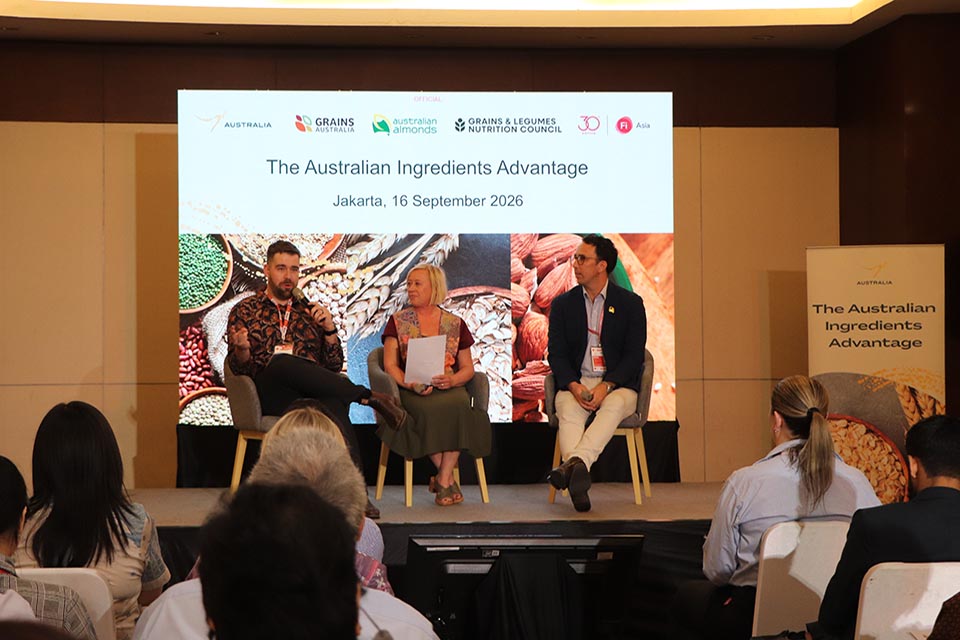
Left to right: Lachlan Evans, Trade and Market Access Manager, Grains Australia; Katherine La Macchia, General Manager, Grains and Legumes Nutrition Council; and Tom Cooper, Trade Engagement Manager, Almond Board of Australia, highlighted the Australian ingredients advantage at the seminar.
3. Suppliers need to anticipate and respond to fast moving trends
Many food and beverage trends like fibre, protein and collagen are driven by large domestic and global manufacturers. Once adopted by market leaders, concepts can spread quickly across the market. Australian food ingredient suppliers can work with local manufacturers to help them adapt to emerging food and beverage trends.
4. Manufacturers are seeking integrated solutions, not standalone ingredients
Manufacturers want technical solutions that improve product performance, support innovation and create product differentiation. Australian suppliers can provide technical expertise and practical applications to turn ideas into market-ready products, complemented by strong partnerships with local manufacturers.
Supporting exporters through ANMI
These insights highlight the value of the Accessing New Markets Initiative (ANMI). Designed and jointly delivered by Austrade and TDN partners, ANMI helps Australian businesses to diversify into new export markets, capitalise on growth opportunities in established markets, and build long-term resilience.
‘It is a pleasure to be part of the ANMI program and work with Austrade to promote Australian almonds in new markets around the world,’ says Tom Cooper, Trade Engagement Manager, Almond Board of Australia.
‘We have established markets, but having support on the ground is pivotal. It allows us to visit the region, meet distributors and connect with the people our exporters need to reach to get their products into market.’
‘Our success is connected,’ adds Lachlan Evans, Trade and Market Access Manager, Grains Australia. ‘We are here to strengthen trusted relationships, build new customer connections and create new trade opportunities between Australia and Indonesia.’
Sign up to receive the latest news and insights about Southeast Asia.
Go further, faster with Austrade
Austrade’s Go Global Toolkit helps you learn the export basics, find the right markets and understand market requirements.