For Australian businesses experiencing supply chain volatility and disruptions, visit the Go Global Toolkit for the latest updates and support available.
Australia has a longstanding partnership with the Asian Development Bank (ADB), reflecting its commitment to advancing development across the region.
Australian firms consistently rank among the leading recipients of ADB-funded consulting work. In 2025, Australian companies secured more than 200 consulting contracts and over US$31 million in goods, works and related services contracts.
In recognition of the partnership, Austrade supported 52 representatives from 32 companies and 7 partners to attend ADB’s annual Business Opportunities Fair in Manila from 21–24 September. The strong turnout showed Australia’s interest in backing the region’s development priorities.
A highlight of the program was the participation of Assistant Minister for Immigration and Foreign Affairs and Trade, Matt Thistlethwaite, in a breakfast forum. He was joined by Philippine Department of Energy Secretary Sharon Garin and other senior government representatives, reinforcing the need for Australia to work with governments of the region on sustainable and inclusive development.
Austrade also organised an Australia-New Zealand-Pacific Business Roundtable to discuss how ADB, Australian and New Zealand businesses can work together to deliver infrastructure, energy, transport, water and development projects across the Pacific.
The roundtable provided insights into:
- Pacific development priorities over the next 3–5 years
- emerging investment areas across energy, transport, water and infrastructure
- upcoming opportunities for industry participation
- areas where ADB would benefit from greater industry capability and innovation.
Following the Manila program, delegates travelled to Jakarta to broaden their regional networks and gain more insights into development priorities and partnership opportunities across Southeast Asia.
Austrade hosted a Development Opportunities Forum to highlight project opportunities aligned with Australian capabilities, particularly in infrastructure, transport connectivity and water. Delegates also learned about current Australia–Indonesia development initiatives and collaborations, including through KINETIK (the Australia–Indonesia Climate and Sustainable Infrastructure Partnership) and the Australian Government’s Investment Deal Teams.
The importance of partnerships and local understanding
A common theme emerged across the sector-focused roundtable discussions: development challenges are increasingly interconnected.
Governments are investing in infrastructure that:
- supports growing populations
- accelerates the energy transition
- strengthens resource security
- improves climate resilience.
Urbanisation and regional integration are also driving demand for modern transport networks, sustainable cities and smarter public infrastructure.
Technology, agriculture and private-sector finance discussions highlighted the growing role of innovation in improving productivity, financial inclusion, public service delivery, food security and supply chain resilience.
Development partners are also placing greater emphasis on mobilising private capital alongside public investment, creating opportunities for organisations that can deliver both commercial value and development impact.
In Indonesia, discussions underscored the importance of partnering with local organisations and understanding local content requirements, delivery capability and operational needs to successfully implement projects.
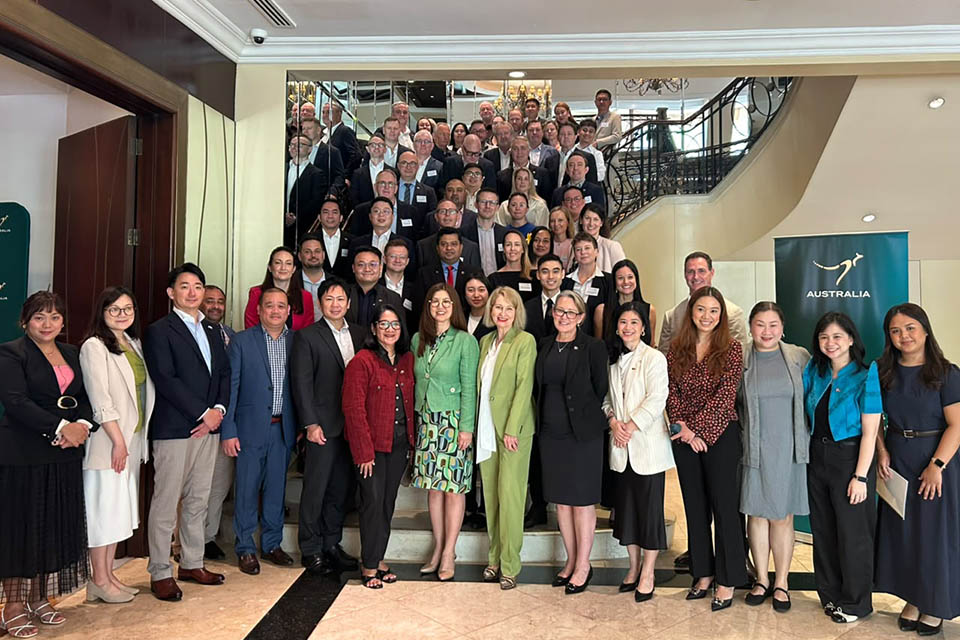
The Australian business delegation travelled to Manila to learn more about development priorities at the ADB’s annual Business Opportunities Fair.
ADB’s development priorities
ADB’s growing scale reflects increasing demand for development investment across Asia and the Pacific. In 2025, the bank committed US$29.3 billion from its own resources, a 20% increase on the previous year, complemented by US$14.7 billion in partner co-financing.
More than 90% of commitments were concentrated in South Asia (33%), Southeast Asia (31%), and Central and West Asia (28%), highlighting where development activity and opportunities are expected to be strongest.
ADB’s investments continue to focus on economic growth, connectivity, and institutional reform, with the largest allocations directed towards finance (24.9%), transport (17.1%) and public sector management (15.1%).
Of the bank’s total commitments, US$23.5 billion was allocated to public sector projects and US$5.5 billion to private sector programs. Around half of public sector investments supported infrastructure, policy reforms, and institutions designed to unlock private capital.
These investments are expected to improve infrastructure, financial services. and agricultural productivity for approximately 120 million people. A further 61 million people are projected to benefit from enhanced healthcare, education, and social protection services.
The future of development partnerships
The ADB Business Opportunities Fair reinforced that development opportunities are no longer defined solely by projects or procurement processes. Increasingly, governments and development institutions are seeking partners that can help address long-term priorities, including infrastructure, climate resilience, energy transition, and digital transformation.
For Australian organisations, the opportunity extends beyond winning contracts to helping deliver lasting economic and social impact across Southeast Asia and the Pacific.
For more information, visit the Asian Development Bank website or contact Sheila Trance, Business Development Manager, Austrade.
Sign up to receive the latest news and insights about Southeast Asia.
Go further, faster with Austrade
Austrade’s Go Global Toolkit helps you learn the export basics, find the right markets and understand market requirements.