For Australian businesses experiencing supply chain volatility and disruptions, visit the Go Global Toolkit for the latest updates and support available.
Australian health technology companies explored opportunities to support more accessible, efficient and patient-centred care at the Association of Private Hospitals of Malaysia Conference & Exhibition (APHM). The annual event is one of Southeast Asia’s largest healthcare gatherings.
Austrade and Investment New South Wales led 15 Australian healthcare innovators to Malaysia as part of the Australia-Southeast Asia Business Exchange program.
‘Australia’s healthcare innovators are partnering with healthcare providers across the region to address some of the sector’s most pressing challenges,’ says Helen Oh, Trade and Investment Commissioner, Austrade.
‘From enhancing workforce productivity and hospital operations to supporting early detection, specialised care and recovery at home, these solutions are helping create more sustainable and patient-centred healthcare systems.’
Opportunities for Australian healthcare providers
A clear theme during the conference was the growing focus on delivering value in healthcare. Discussions reflected the increasing pressure on health systems to balance rising costs, workforce challenges and growing patient expectations, while maintaining quality outcomes.
Malaysia’s health industry leaders highlighted the need to move beyond measuring activity and volume alone, towards demonstrating measurable improvements in patient outcomes, operational efficiency and healthcare accessibility.
Another key takeaway was the accelerating adoption of digital health and artificial intelligence. Malaysia is building AI-ready hospitals, improving care coordination, enhancing clinician productivity and using data more effectively to support safer and more efficient healthcare delivery.
These trends and operational priorities align closely with areas where Australian healthcare organisations have developed globally recognised expertise. The delegation included companies offering AI-enabled clinical documentation, digital health, diagnostics, rehabilitation, cancer care and patient engagement.
‘The interest we saw from healthcare providers across the region reinforced the opportunities for deeper Australia-Southeast Asia collaboration in hospital transformation, digital health, medical technologies and healthcare workforce solutions,’ says Oh.
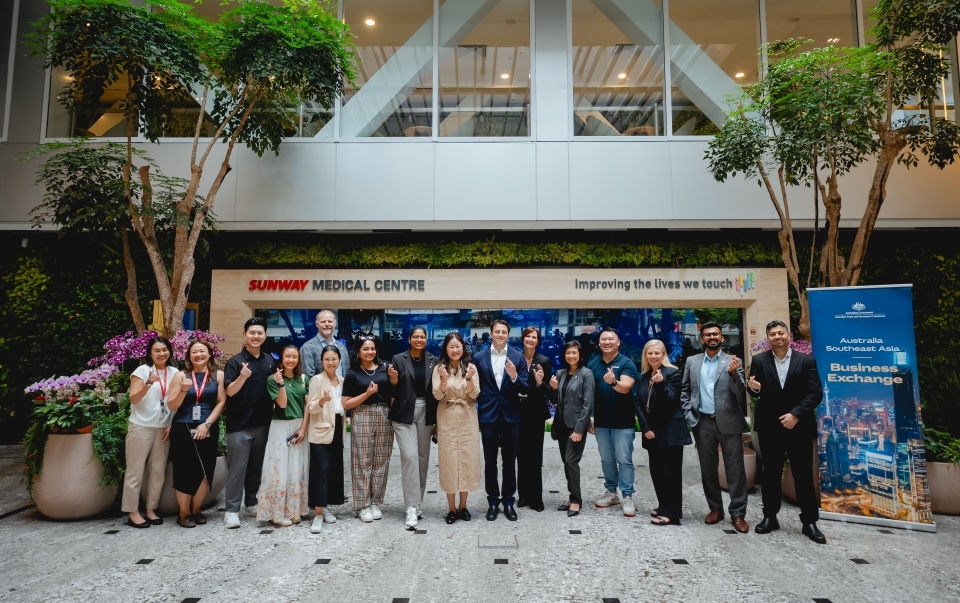
The Australian delegation visited Sunway Medical Centre to gain first-hand insights into opportunities across Malaysia’s private healthcare sector.
Connecting Australian innovators with Malaysian healthcare providers
The delegation showcased their solutions at the Australia Pavilion at APHM, highlighting practical approaches to improving productivity and patient outcomes.
Austrade also hosted a Lunch Symposium at APHM, bringing together Australian healthcare innovators and Malaysian healthcare providers to exchange insights and explore collaboration opportunities. Discussions focused on how emerging technologies can support healthcare transformation in Malaysia’s healthcare ecosystem.
The delegation also visited Sunway Medical Centre, gaining first-hand insights into opportunities across Malaysia’s private healthcare sector. These opportunities are being driven by expanding medical tourism, an ageing population and increasing digital health adoption.
‘The strong interest from Malaysian healthcare organisations reflects the sector's growing focus on innovation, productivity and better patient outcomes,’ says Gregory Harvey, Trade and Investment Commissioner, Austrade Malaysia.
‘It also demonstrates the opportunities for Australian companies to contribute their expertise in digital health, medical technologies and specialised healthcare services while building long-term partnerships in the market.’
Practical solutions for healthcare transformation
A key focus of the mission was improving healthcare productivity through AI, automation and digital health technologies. Heidi Health, AgiliMed, Aptium.ai, Kiratech and Nabu AI showcased solutions that reduce administrative burden, automate workflows and enhance patient engagement.
Other Australian companies demonstrated capability across hospital operations, early detection, disease management, specialised care and recovery beyond the hospital setting. Alcidion’s health informatics platform helps hospitals optimise patient flow and clinical decision-making, while AES Environmental’s solution supports contamination control and critical healthcare environments.
Eyeonic, HA Tech, Better Breathing and Curezma Pharmaceuticals presented solutions across glaucoma detection, diagnostic and biopharmaceutical technologies, respiratory therapy and eczema care. Icon Group highlighted its integrated cancer care services across Malaysia and Southeast Asia. Lusio Rehab and Fit2Fly showcased solutions that support rehabilitation, mobility and healthcare management beyond traditional clinical environments.
Sign up to receive the latest news and insights about Southeast Asia.
Go further, faster with Austrade
Austrade’s Go Global Toolkit helps you learn the export basics, find the right markets and understand market requirements.