
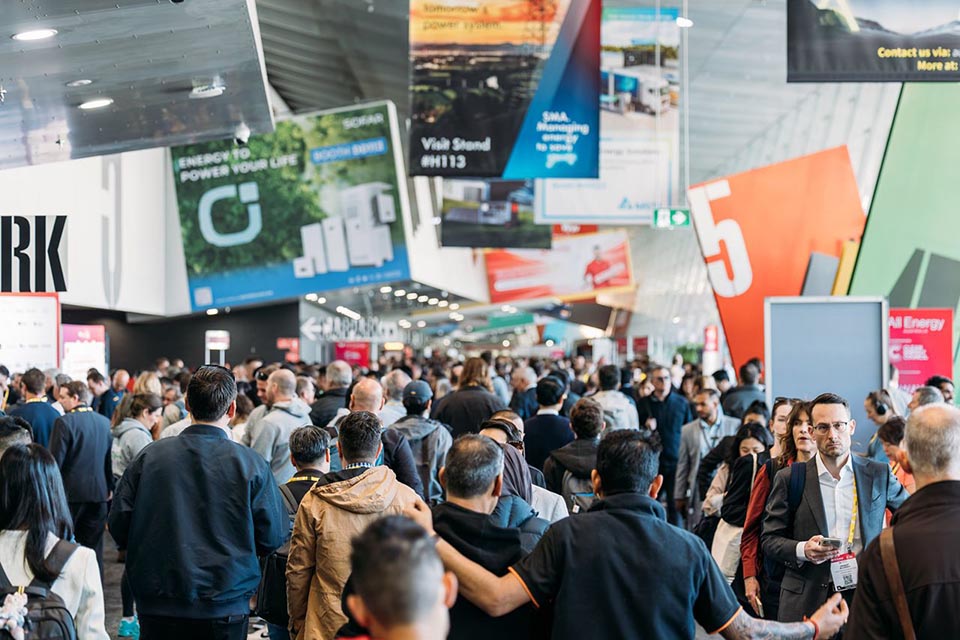
Australia’s experience in clean energy captured global attention at All Energy Australia, APAC’s largest clean energy business-to-business exhibition and conference.
Supported by the Accessing New Markets Initiative, Austrade and the Smart Energy Council partnered to showcase Australian clean energy expertise at the event. The Smart Energy Council is a member of the Trade Diversification Network working with government to help Australian renewable energy businesses explore international opportunities.
Smart Energy Council CEO David McElrea says customers in Southeast Asia, South Asia and the Pacific are looking to Australia for specialist knowledge, particularly in grid and system design and the services needed to support renewable energy projects.
‘We’re doing things in Australia that the rest of the world isn’t doing,’ he says. ‘We’re really excited to take that Australian knowledge and skills to the world and really grow our industry.’
Austrade also hosted trade and investment delegations from Brazil, Germany, Japan, New Zealand, the Pacific, Southeast Asia and the United States. The visit program included meetings with Australian businesses, briefings with state governments, networking sessions, and site visits to CSIRO, the Monash Grid Innovation Hub and other locations. These activities gave delegates a deeper understanding of Australia’s capabilities and opportunities, including in renewable energy, battery storage, grid modernisation and more.
Below, Austrade representatives discuss opportunities in New Zealand and the Pacific, the Philippines, Germany and Brazil – and how Australian products, services and expertise can support the energy transition in these markets.
New Zealand and the Pacific: Batteries and grids in demand
New Zealand is a small but sophisticated energy market. While renewables already account for more than 88% of New Zealand’s electricity generation, growing electricity demand and electrification are driving a new phase of investment.
Transpower estimates that New Zealand may need to develop and connect as much new electricity generation over the next 15 years as it built over the previous 40 years.
Australia’s experience integrating large-scale renewable energy, battery storage and distributed energy resources into the electricity system gives Australian businesses capabilities that are increasingly relevant to New Zealand’s next phase of electrification.
‘For Australian businesses, this is creating opportunities in battery storage, grid modernisation and integration, distributed energy and digital energy solutions,’ says Auckland-based Business Development Manager Aude Douyere. ‘It’s not only about generating more renewable electricity, but also about how you store it, move it around the system and manage it more efficiently.’
Local partnerships, an understanding of the regulatory and procurement environment, and solutions appropriate to the scale of the market can be just as important as the technology itself.
In the Pacific, opportunities include solar-plus-storage, microgrids and resilient energy systems, particularly for smaller or remote island grids. Projects supported by development partners and multilateral development banks such as the Asian Development Bank can also create opportunities for Australian companies.
Businesses can explore upcoming projects and procurement opportunities through the Pacific Infrastructure Pipeline(Opens in a new tab/window), an initiative supported by Austrade and other Pacific development partners.
The Philippines: thousands of islands, one energy challenge
Australian businesses with expertise in renewable energy technologies and services can help the Philippines tackle its energy challenges.
‘Australia’s experience delivering energy across a geographically dispersed population is particularly relevant to the Philippines, a vast archipelago of thousands of islands,’ says Bernice Vanguardia, Trade and Investment Commissioner in Manila.
Vanguardia adds that Australia’s energy consulting expertise is highly regarded and sought by government agencies and major companies working on solar, offshore wind, hydrogen and other energy projects.
Some projects may also attract funding through multilateral development banks, including the Asian Development Bank, creating further opportunities for Australian businesses.
Germany: shared challenges, different experience, innovative solutions
Australia’s unique geography and grid conditions have accelerated the deployment and integration of grid-scale battery energy storage systems. Battery storage can help manage fluctuations in renewable energy and potentially save billions in grid investment.
Berlin-based Trade and Investment Director David Urry says Australia’s early adoption of battery storage has given local businesses valuable experience from which German grid and distribution network operators, regulators and other energy-sector participants are keen to learn.
‘We brought a delegation from Germany that is interested in learning from Australia how it might include battery storage systems in their grid development strategy,’ he says.
Some Australian companies have already recognised the commercial opportunity and established operations in Germany.
But Urry warns that Germany is a highly competitive market, and Australian businesses cannot assume their experience alone will guarantee success in Germany.
‘But there are always niches in any given market, so my advice is to consider what makes your product unique and do your homework,’ he says. ‘You’ll find areas where Australia is further along the digitisation chain, or where we’ve addressed a problem that hasn’t yet come up in Germany.’
Brazil: a renewable energy powerhouse looking for Australian expertise
Brazil already has a substantial renewable energy industry. But expanding its clean energy capacity and modernising its electricity network are creating opportunities for Australian technology and services.
‘Australian products and services and the Australian brand are highly regarded in Brazil,’ says São Paulo-based Business Development and Investment Director Fabio Nave.
‘We see great opportunities in sustainable aviation fuel. We also see opportunities in transmission lines and grid modernisation technologies and equipment.’
But the opportunity isn’t limited to Australian exports. Brazilian investors are also exploring opportunities in renewable generation, battery storage and transmission infrastructure.
Nave says Australia’s stable institutions, skilled workforce and established clean energy capabilities make Australia ‘a very interesting market for Brazilian and South American investors.’
Go further, faster with Austrade
Austrade’s Go Global Toolkit helps you learn the export basics, find the right markets and understand market requirements.