For Australian businesses experiencing supply chain volatility and disruptions, visit the Go Global Toolkit for the latest updates and support available.
Fusetec is on a quest to revolutionise surgical training around the world with its lifelike advanced manufactured human body parts.
The company designed and developed around 180 body parts and is continually developing more. The organs and bones are made of hard and soft materials to closely replicate the human anatomy.
Fusetec currently exports to around 70 countries. A key market is the United States, where it has opened a manufacturing hub at the University of Utah’s new medical simulation training centre, the Sorenson Center for Medical Innovation.
Fusetec’s goal is to upskill surgical registrars and continue advancing surgeons’ skills around the world by allowing them to rehearse and master their skills on realistic models instead of cadavers, animals and patients.
‘Currently, surgical training is done on either living people or cadavers,’ says Fusetec Chief Executive Officer Mark Roe. ‘The human body is unpredictable, no two are identical, so that makes it challenging to create a measurable global standard.
‘We believe surgeons should have access to the most realistic training possible.’
A new way to train surgeons
Having worked in manufacturing for more than 3 decades, Roe and Fusetec’s Chief Operating Officer, John Budgen, founded the Adelaide-based medtech company in 2017.
The pair believe their products can lead to reduced financial pressure on healthcare systems, while freeing up hospital beds and saving lives.
‘Every year, a huge number of people around the world experience surgical complications, many requiring additional treatment or repeat surgery,’ says Roe.
This stems from shortcomings in surgical training. Budgen points to paediatrics as an example.
‘There are very limited opportunities for cadaver-based training for a paediatric surgeon due to the limited accessibility of paediatric cadavers,’ he explains. ‘You have doctors who are performing operations on children for the first time. Paediatric simulation will change the way surgeons master their skills in the future.’
It takes a team of engineers about 2 years to develop a standard model, which can be customised with patient-specific details for simulation training.
‘We are grateful to have received many commissions from medical device companies to develop specific surgical training models to fill a need in the market,’ says Budgen. ‘This has varied from an airway model for a three-month-old baby, to an adolescent with a spinal scoliosis curvature and total knee arthroplasty models.’
Fusetec can also replicate a brain with a tumour, overcoming the access and shipping challenges posed by real brain tissue, which deteriorates within days.
Success in the US
The US emerged as a preferred market due to its size, strong investment in medtech and reputation as a hub for medical device companies.
Fusetec saw immediate demand, exporting across the US just months after its first product launched in Canada in 2019.
But when COVID-19 hit, operations came to a halt.
For Roe and Budgen, it was devastating.
‘We did not sell any surgical training models for years,’ says Roe. ‘But we had developed a global reputation as the world’s best at advanced manufacturing of human body parts. We survived on commissions to develop new models that would be required post-COVID.’
Giving up was never an option for the pair, who backed themselves to overcome all obstacles.
As restrictions eased, the company hosted surgical training workshops around the world to showcase products to medical professionals.
One proved fruitful when a clinical leader from the University of Utah recognised the potential of moving beyond cadaver-based training.
That connection led to Fusetec opening a manufacturing hub within the university’s new multimillion-dollar medical simulation training centre. It means the products are manufactured and used to train surgeons from the same location.
‘Now that we are collaborating with a university, we have a shift in how we are looked at,’ Roe says.
‘We are not just a supplier but a collaborative partner, and the University of Utah becomes our credibility engine in America.’
Fusetec subsequently opened a sales and administration office in Florida.
The company is in talks about similar commercial partnerships with a handful of top-tier universities in the UK.
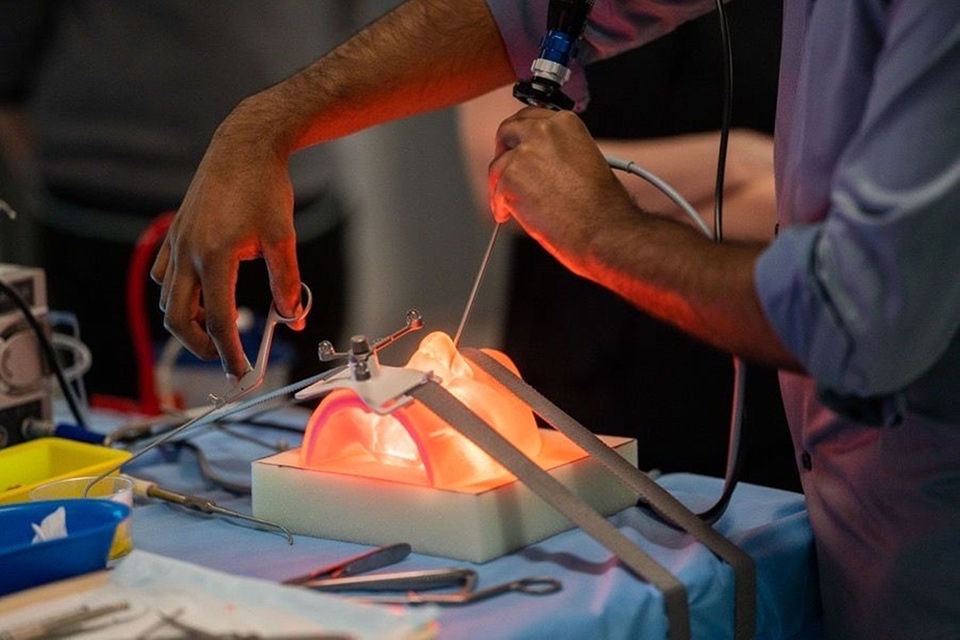
Fusetec’s lifelike 3D body parts are helping train and upskill surgeons around the world.
Overcoming challenges on the road to success
However, the pandemic hasn’t been the only roadblock on the path to market.
Fusetec has to navigate different customs rules when shipping to dozens of countries. More recently, the conflict in the Middle East has seen the company miss delivery deadlines for the first time in 8 years.
Recent changes to US tariff policy have added to the complexity of market strategies.
‘Rules and regulations in the US are changing constantly, and we even had one shipment returned as it was packed in a metal briefcase,’ says Roe. ‘With orders slipping due to changing circumstances, establishing a manufacturing site in the US has helped overcome the challenges posed on Australian-made products.’
Leaning on Austrade
About 2 years into business, Fusetec contacted Austrade for support in analysing global demand and trade barriers.
Since then, Austrade has been a constant presence in the company’s export journey. Roe and Budgen have taken part in many Austrade-led missions, including to San Diego, the UAE, Hong Kong and China.
‘Austrade introduced us to new networks and opportunities, which led to connections in the UK and gave us credibility with the UK Government,’ says Budgen.
‘Those relationships then opened doors in Israel, Saudi Arabia, China and Japan.’
Fusetec says Austrade’s market knowledge and local connections have been invaluable to the company’s growth.
‘I've made several mistakes in business, but one of the biggest was not engaging with Austrade sooner,’ Budgen says.
Expertise on the ground
Another key lesson has been the importance of local market expertise.
‘When we were offered the opportunity in Utah, we engaged with Austrade to determine whether it was the right business decision and how to set up in the US,’ Roe says.
Austrade provided practical guidance on establishing US operations, including connecting Fusetec to lawyers and accountants who continue to support the business.
‘A lot of the infrastructure is very different in the US, from employment law to payroll and the tax systems,’ explains Roe.
‘You can’t take what works in Australia and hope that it works there. We outsource those functions because the last thing we want is to overlook a tax obligation.’
Opportunities for medtech firms in the US
Despite the highs and lows of expanding into international markets, Roe and Budgen believe Australian medtech companies have many opportunities to make their mark in the US.
The US is one of the world’s largest medtech markets, supported by significant public and private investment. According to the National Institutes of Health, it invests around US$47 billion into biomedical research every year.
While Australia’s geographical distance presents challenges, Roe says the country is highly respected within the global medical industry and is known as a good place for research and clinical trials.
He says medtech start-ups should do their homework and take advantage of government-led support programs.
‘Don’t just go over there thinking it’s a big market and you’re going to smash it, because you might get gobbled up instead,’ Roe says.
‘Do your due diligence and take your time,’ Budgen adds.
Go further, faster with Austrade
Austrade’s Go Global Toolkit helps you learn the export basics, find the right markets and understand market requirements.