For Australian businesses experiencing supply chain volatility and disruptions, visit the Go Global Toolkit for the latest updates and support available.
The University of Melbourne is taking transnational education one step further with dual-degree courses for Indian students. The pioneering Bachelor of Science Advanced Honours allows undergraduate students to complete 2 years at their home university in India, followed by 2 years in Melbourne.
The curriculum has been agreed between the Faculty of Science at the University of Melbourne and participating institutions in India.
‘With our dual degrees, Indian students can go anywhere in the world knowing their qualification will be recognised,’ says Professor Muthupandian Ashokkumar, Director of Melbourne Global Centre – Delhi and Deputy Pro Vice Chancellor International (South Asia & Middle East).
‘They graduate with the breadth, depth and experience needed to enter the workforce or move on to further study.’
Australian university with a global reach
Established in 1853, the University of Melbourne is Australia’s second oldest university. It is home to more than 58,000 students, of which 46% are international students from more than 150 countries.
In 2013, the University started the Melbourne India Postgraduate Program (MIPP), a collaborative PhD program with Indian institutions in Chennai, Kharagpur and Kanpur. The program involved approximately 15 PhD students per year.
The program allowed doctoral candidates to spend 1–2 years of their research programs in Australia and gain dual degrees from both their home university and the University of Melbourne.
‘Our jointly supervised and dual PhDs have been a great success,’ says Ashokkumar. ‘To date, 75 students have benefitted from this program.
‘In 2016, we also started working with the University of Pune to develop a blended Bachelor of Science degree. That quickly became a success as well.’
National Education Policy opens new opportunities
In 2020, the Government of India launched its transformational National Education Policy (NEP). The NEP introduced a new, multidisciplinary structure for 4-year undergraduate degrees and loosened degree entry and exit options.
This created fresh opportunities for the University of Melbourne in India, which launched the Bachelor of Science Advanced Honours dual-degree program in 2024. This involved students spending their first 2 years of academic study in India, followed by 2 years on campus at the University of Melbourne.
To date, participating universities include Shoolini University, Amity University and Manipal University Jaipur.
‘Our dual degrees cover science and technology subjects, and we are working on dual degrees in humanities, arts and social sciences,’ says Professor Michael Wesley, the University’s Deputy Vice Chancellor (Global, Culture and Engagement).
‘This allows us to offer students a rigorous academic foundation that will open up outstanding career opportunities.’
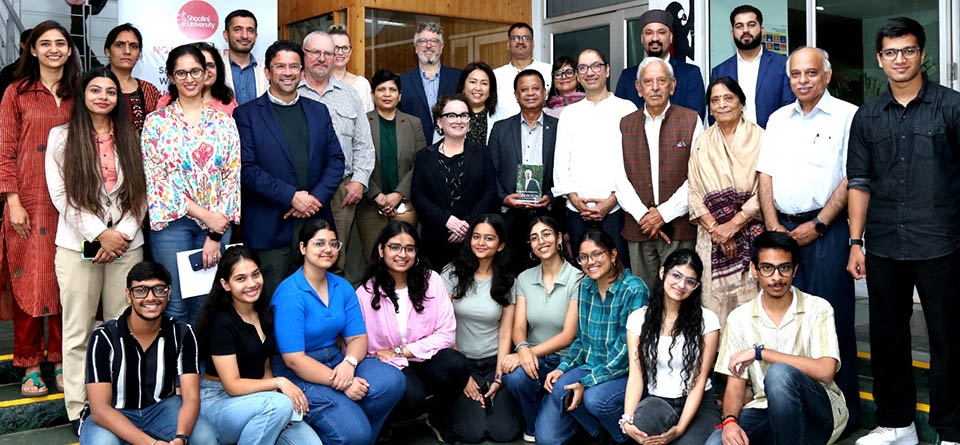
Inaugural Bachelor of Science Advanced (Honours) cohort at Shoolini University pictured with members from University of Melbourne and Shoolini University. Image courtesy of University of Melbourne.
Austrade promotes innovative degrees in India
The university worked with Austrade advisers to launch their blended and dual-degree initiatives.
‘We worked with Austrade from day one,’ says Ashokkumar. ‘Austrade’s “badge of government” helped us showcase our initiative during ministerial trade visits. This brought our dual-degree idea to the notice of top government officials in India.’
Austrade advisers also promoted the dual degrees at regional delegations and helped with industry connections.
‘Industry partnerships are vital,’ says Ashokkumar. ‘Our graduates need work experience, so they can access opportunities in the Indian workforce when they complete their program.’
International academic success
According to Professor Moira O’Bryan, Dean, Faculty of Science, graduates from Pune have gained higher scores in national rankings thanks in part to the blended curriculum.
‘A high proportion of graduates have been awarded scholarships to international universities,’ she says.
‘We are giving our students a global competitive edge – an international curriculum is a passport to international careers.’
Plans for future expansion
The first cohort of dual-degree students arrived in Melbourne in 2026, and the university already has plans for expansion. This includes creating a one-year master’s option and expanding the program to Indian universities.
‘For example, the State Government of Andhra Pradesh is building a new technology city – Quantum Valley – and it wants academic institutions to become involved,’ says Ashokkumar. ‘In response, we want to develop a program in quantum sensing.
‘We will start small, but we anticipate launching programs for around 100 students. Then we will scale up to higher numbers based on demand.’
Go further, faster with Austrade
Austrade’s Go Global Toolkit helps you learn the export basics, find the right markets and understand market requirements.