For Australian businesses experiencing supply chain volatility and disruptions, visit the Go Global Toolkit for the latest updates and support available.
A recent trade event highlighted the substantial opportunities for Australia to supply wool and cotton to meet the changing demands of Bangladesh’s manufacturing sector.
The Australian Natural Fibre Seminar marked a milestone in the Australia-Bangladesh textile partnership, and paved the way for deeper supply chain integration.
Organised by Austrade, the event brought together for the first time Australia’s top wool and cotton experts and Bangladesh’s key textile industry stakeholders, including the Bangladesh Textile Mills Association.
The event was inaugurated by the Australian High Commissioner, Susan Ryle, underscoring the deep commitment to expanding bilateral agricultural trade ties between the 2 nations. The seminar supported a long-term strategy to position premium Australian natural fibres at the centre of Bangladesh’s ready-made garment sector.
‘The textiles industry in Bangladesh is prioritising modernisation, sustainable sourcing, fibre recycling and product diversification,’ says Todd Miller, Austrade’s Trade & Investment Commissioner for South Asia. ‘There are excellent growth and diversification opportunities for Australia to supply both premium wool and cotton raw materials.
‘Australia’s advanced capabilities in carbon tracking and eco-friendly agricultural exports align perfectly with the emerging demands of Bangladesh’s export-oriented apparel sector.’
Supporting a move towards more sustainable materials
Discussions focused heavily on eco-friendly farming practices, high-tech fabric innovations, and emerging business opportunities. Australian experts shared updates on global sustainability standards and carbon footprint tracking. These updates provided actionable pathways to help Bangladesh transition away from synthetic materials toward premium natural fibres.
The Department of Agriculture, Fisheries and Forestry (DAFF) also emphasised the strategic importance of Southeast Asian and South Asian markets to Australian agriculture. DAFF outlined the support services available to international partners looking to tap into new raw material streams.
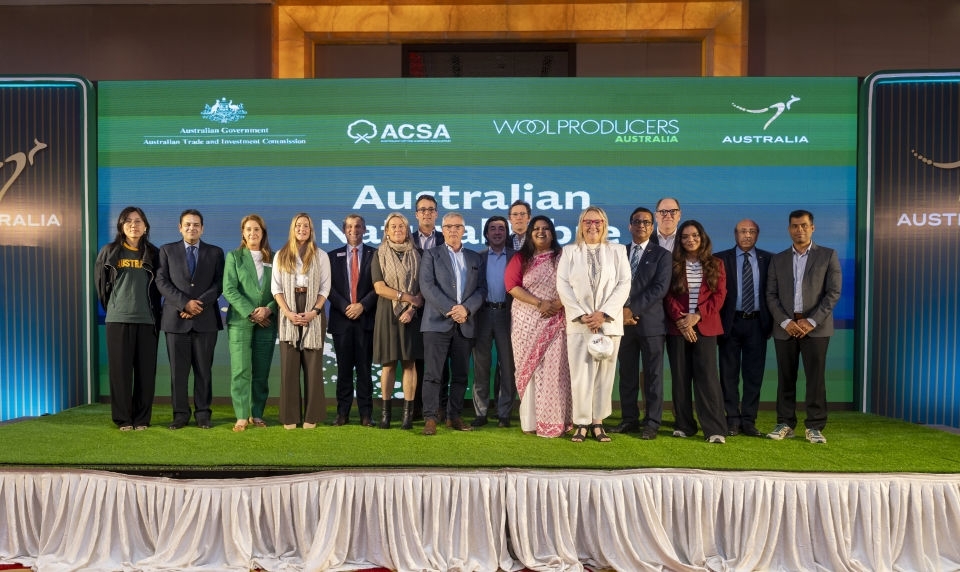
Delegates from Wool Producers Australia and Australian Cotton Shippers Association with the Austrade team.
Forging industry and stakeholder connections
The event also encouraged commercial engagement, connecting Australian peak industry bodies with local manufacturers to unlock market potential.
Key industry leaders met with local stakeholders to explore innovative applications and expand commercial diversification opportunities for Australian wool, cotton, and advanced wool-cotton blends. Participating organisations included:
- Wool Producers Australia (WPA)
- Australian Cotton Shippers Association (ACSA)
- Australian Wool Exchange (AWEX)
- The Woolmark Company
- Michell Wool.
Understanding local capabilities
The Australian delegation also visited manufacturing facilities across major industrial zones, including:
- the Korean Export Processing Zone (KEPZ) / Youngone Corporation, alongside a dedicated market visit to Chittagong, to evaluate technical textile capabilities
- Badsha Textiles, a premier spinning mill in Valuka, to explore scaled manufacturing opportunities for both wool and cotton lines
- Square Textiles in Gazipur to review local high-performance spinning operations.
These visits gave Australian organisations a better understanding of local manufacturing capabilities and allowed them to assess specialised infrastructure at the facilities.
To learn more about these emerging supply chain opportunities in Bangladesh, contact Austrade Dhaka.
Go further, faster with Austrade
Austrade’s Go Global Toolkit helps you learn the export basics, find the right markets and understand market requirements.