For Australian businesses experiencing supply chain volatility and disruptions, visit the Go Global Toolkit for the latest updates and support available.
Australia has strengthened its relationship with international grain, pulse and oilseed buyers following an inbound mission that showcased Australia’s supply chain capability and reliability.
Forty international grain buyers from India, China, Vietnam and the Philippines travelled to Australia in late July to attend the Australian Grains Industry Conference (AGIC) 2026 and participate in a program of activities. Trade Diversification Network member Grain Trade Australia delivered the mission, with support from the Australian Government’s $55 million Accessing New Markets Initiative (ANMI).
The program connected buyers with Australian exporters, industry leaders and government representatives through business meeting sessions, industry briefings, technical discussions and site visits to Horsham and the Port of Geelong.
By anchoring the inbound mission around AGIC, the program provided international customers with a direct view of Australia’s grain supply chain, from production and logistics through to export infrastructure and market capability.
Showcasing Australia’s grain industry firsthand
For many delegates, AGIC Week 2026 was their first opportunity to visit Australia and engage directly with the country’s grain sector.
More than half of the international buyers had not previously travelled to Australia. The program was thus an important opportunity to build understanding, trust and commercial relationships with key customers across priority markets.
The program showcased the strength, reliability and sophistication of Australia’s grain, pulse and oilseed supply chain. Site visits to Horsham and the Port of Geelong gave buyers insights into production systems, technology applications, handling, logistics and export pathways.
The approach received strong feedback from international customers and Australian exporters, with participants highlighting the value of seeing Australia’s grain capability in context and connecting directly with the people and businesses behind the supply chain.
Connecting buyers and exporters
Business matching was a central feature of AGIC Week, creating targeted opportunities for international buyers and Australian exporters to discuss supply needs, market trends and future commercial opportunities.
Across two half-day sessions, more than 200 business meetings were delivered between international customers and Australian exporters.
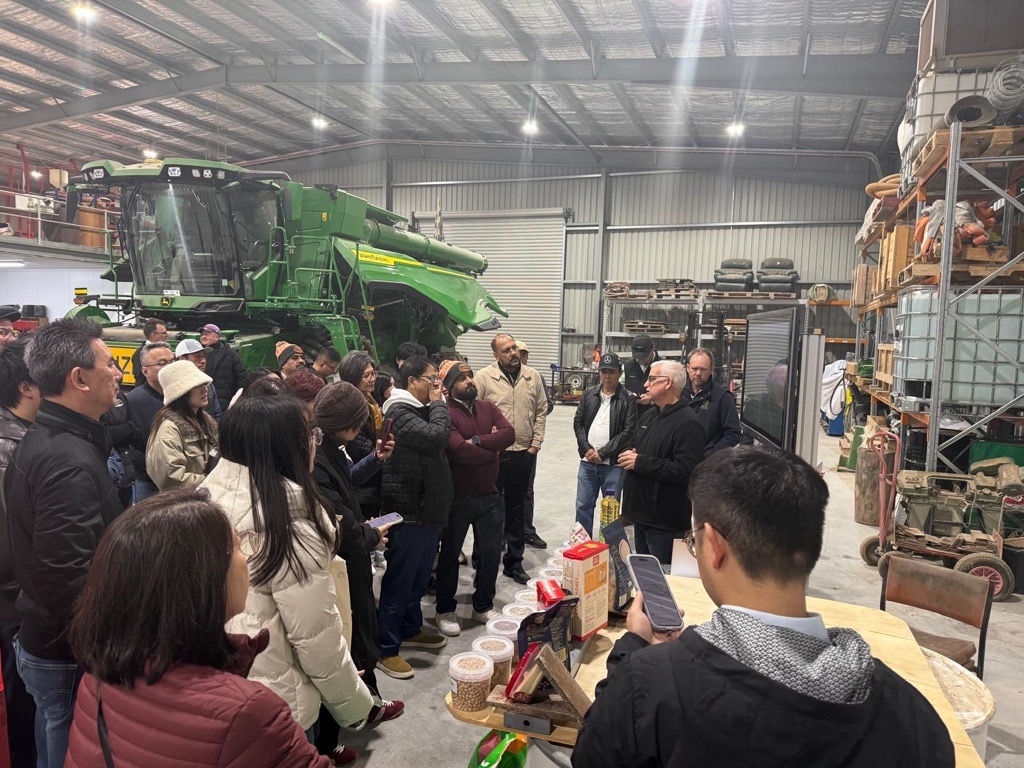
Delegates on the inbound mission had opportunities to engage with exporters in the Australian grain sector.
Industry and government collaboration strengthens trade outcomes
AGIC Week 2026 demonstrated the value of coordinated industry and government collaboration in supporting Australia’s grain export ambitions.
The program was supported by ANMI and delivered through strong partnerships between Grain Trade Australia, Grains Australia and Austrade. This industry-government partnership helped create a platform for exporters to engage with international customers, strengthen market relationships and identify new pathways for growth.
The week was further strengthened by contributions from Dr Jared Greenville, First Assistant Secretary of the Trade and International Division at the Department of Agriculture, Fisheries and Forestry, and Su McCluskey, Australia’s Agriculture Trade Diversification Representative at the National Farmers’ Federation.
Their insights explored the global trade outlook, agricultural competitiveness, market diversification and opportunities for Australian agriculture in an increasingly complex international trading environment.
Austrade Trade Commissioner Todd Miller also delivered a session on grain opportunities in South Asia. He highlighted emerging demand trends, market diversification opportunities and pathways for Australian exporters to grow their presence across one of the world’s fastest-growing grain-importing regions.
‘The AGIC Conference gave me the chance to meet and seek insights with the grains industry, in relation to the South Asia region,’ he says. ‘It was also an honour to present current market insights and opportunities on this important region for Australia. It was also great to have a delegation from India led by the India Grains & Pulses Association.’
Supporting export diversification through ANMI
As global grain customers look to build more resilient and diversified supply chains, Australia is well placed to strengthen its role as a trusted supplier.
AGIC Week 2026 created practical opportunities for Australian exporters to engage with buyers from established and emerging markets, build new relationships and reinforce Australia’s reputation for quality, reliability and supply chain capability.
The success of the inbound mission showed the value of bringing international customers to Australia, particularly when the program is connected to a major industry event such as AGIC. By combining business meetings, technical discussions, site visits and industry engagement, the program helped buyers better understand Australia’s grain, pulse and oilseed offer and created a stronger foundation for future commercial outcomes.
As Grain Trade Australia CEO Pat O’Shannassy noted at the conclusion of AGIC 2026:
‘The conversations, ideas and connections made over the past two days will continue to strengthen Australia’s grain industry well beyond AGIC.’
Through ANMI, Austrade continues to support Australian exporters to access new markets, strengthen international competitiveness and build more resilient trade relationships in priority sectors.
Go further, faster with Austrade
Austrade’s Go Global Toolkit helps you learn the export basics, find the right markets and understand market requirements.