For Australian businesses experiencing supply chain volatility and disruptions, visit the Go Global Toolkit for the latest updates and support available.
In 2024, Australia overtook Norway as the biggest supplier of fresh/chilled salmon to India. This achievement was a direct result of the tariff reduction and improved access under the Australia-India Economic Cooperation and Trade Agreement (AI-ECTA).
Under AI-ECTA, the import duty on fresh/chilled salmon has progressively dropped from 30% in December 2022 to 8.57% currently. The duty will reduce to 4.29% on 1 January 2027 and be eliminated on 1 January 2028.
Signed in December 2022, AI-ECTA spurred exporters like Tassal and Huon to enter the market at competitive rates. After the first few shipments in 2023, salmon exports jumped 287% in 2024 to A$3.5 million. This enabled Australia to overtake long-time market leader Norway.
In 2025, exports jumped a further 35%, solidifying Australia’s status as the leading supplier of fresh or chilled salmon to India. Australia had almost 70% share of the market, valued at almost A$4.5 million.
Table 1: Fresh/chilled salmon exports to India (HS Code: 030214)
| Product code | Product label | Australia's exports to India (in AUD 000s) | ||||
|---|---|---|---|---|---|---|
| 2021 | 2022 | 2023 | 2024 | 2025 | ||
| 030214 | Fresh or chilled Atlantic salmon (Salmo salar) and Danube salmon (Hucho hucho) (excl. fillets) | 0 | 0 | 930 | 3340 | 4521 |
Source: ITC Trade Map, as interperted by Austrade
‘The Australia-India trade agreement has provided the Tasmanian salmon industry with a strong market entry point,’ says Brian Keenan, Senior Manager – International Salmon, Tassal Australia. ‘The reduced import tariffs have encouraged local importers to convert existing sales to Australia’s high-quality, premium Tasmanian Atlantic salmon.
‘As a result, Australian salmon has become well established within the Indian restaurant sector. The fresh salmon category has delivered significant volume growth, and Indian consumers have benefited from a more competitive overall offering.’
Salmon’s success story in India is also a win for small, family-owned businesses in Tasmania. The island’s salmon exports are now approaching a billion-dollar milestone, showing how much global growth opportunities can benefit regional communities.
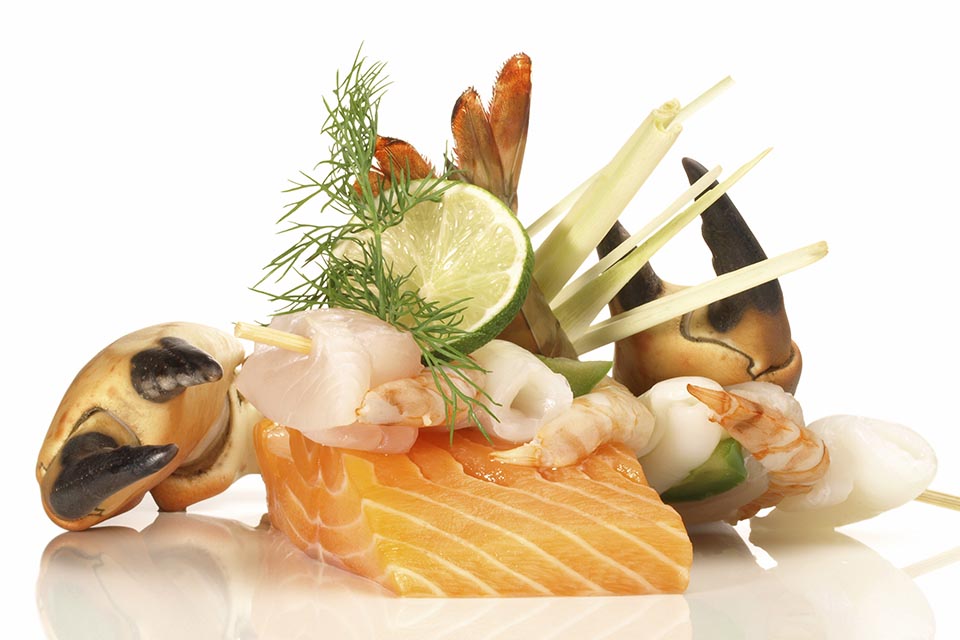
India has developed a taste for premium Australian salmon.
Converting a challenge into an opportunity
The big leap in the number of orders attests to the growing interest in high-end seafood in India. Australian salmon is now served in some of the country’s top hotels and restaurants.
But Australia’s tariff honeymoon is now being challenged.
Last year, Norway signed a free trade agreement with India. The FTA lowered Norway’s import duty on salmon and will eliminate it by 2029.
Australia currently has a small tariff advantage but that is expected to be challenged through aggressive pricing.
Australian salmon exporters must harness their existing supplier deals and leadership position to strengthen relationships and build deep pipelines into India’s hospitality and retail ecosystem. Key to success will be flexibility in addressing pricing concerns and long-term investment in market building.
Indian interest in Australia seafood is growing
AI-ECTA is one part of the story. The second is India’s fast-evolving culinary scene. High-end restaurants and the influence of shows like MasterChef Australia are driving interest in premium ingredients such as salmon and lobster. India also has a deep-rooted love for fish.
‘Indian consumers are increasingly embracing premium seafood, and that’s a real opening for Australian salmon in particular,’ says Todd Miller, Trade and Investment Commissioner, Austrade South Asia. ‘But the opportunity doesn’t stop there. There’s interest across categories such as toothfish, rock lobster and barramundi.’
While fresh/chilled salmon is the largest export category, there is steady growth in demand for other types of seafood. Toothfish, barramundi and, seasonally, tuna, lobsters and oysters have seen growing demand in the past three years.
Toothfish exports jumped almost 57% in 2025 to A$1.7 million. Similarly, the frozen fish category grew by 155% in 2025 to A$1.68 million.
Table 2: Toothfish or Chilean Sea Bass exports to India (HS Code: 030383)
| Product code | Product label | Australia's exports to India (in AUD 000s) | ||
|---|---|---|---|---|
| 2023 | 2024 | 2025 | ||
| 030383 | Frozen toothfish (Dissostichus spp.) (excl. fillets and other meat of HS 0304 and edible fish) | 484 | 1085 | 1700 |
Source: ITC Trade Map, as interpreted by Austrade
Imported seafood to India is a small and slowly growing sector for Australia, where it is currently the market leader. Australian exporters should seize the opportunity to build on the tariff-led success with a concerted strategy.
India’s premium importers are also keen to work with Australian businesses to solidify Australia’s position as a premium seafood supplier and grow the overall size of the market.
‘At Austrade, we’re focused on connecting Australian exporters with the right importers and building the long-term relationships that turn this interest into trade orders,’ says Miller.
Go further, faster with Austrade
Austrade’s Go Global Toolkit helps you learn the export basics, find the right markets and understand market requirements.