For Australian businesses experiencing supply chain volatility and disruptions, visit the Go Global Toolkit for the latest updates and support available.
Australian grid technology company EcoJoule is helping utilities in the UK and Europe adapt to the challenges of net zero. The company’s locally manufactured equipment keeps power stable on local, low-voltage networks.
‘This isn’t bleeding-edge technology – it’s just a novel application of proven technology that is optimised for networks trying to cope with volatile power demand,’ says Martin van der Linde, Chief Commercial Officer, EcoJoule.
EcoJoule can add its equipment to existing electricity poles in just 3 hours. This avoids the need for civil works and council approvals. The company developed its products in Australia, and they are manufactured by a 30-strong workforce in Queensland.
‘EcoJoule is ideal for power utilities in the UK and Europe that are struggling with the same voltage challenges as Australia,’ says van der Linde. ‘Our solution is low-cost and it allows existing networks to cope with the shift to domestic solar, heat pumps and electric vehicles.’
Home-grown, high-tech power solutions
EcoJoule was founded in Loganholme, Queensland in 2014 by entrepreneur, Dr Mike Wishart. His goal: to evolve existing power management technologies into new products and help electricity suppliers adapt to volatile demand on local grids.
‘Our technology is used to regulate voltage,’ says van der Linde. ‘Local power networks in Australia were mostly built 20 to 100 years ago, when loads were small and supply was one-way. Today, that’s all changed.
‘With the move to net zero, demand for domestic power is higher and sometimes power needs to go in 2 directions,’ he adds. ‘Our box-sized compensators and batteries keep voltage in local networks stable, and smooth out volatility in consumption and generation.’
As a low-cost, low-disruption solution, EcoJoule’s technology has proved popular in Australia. The company has also begun to export to Asia, including Malaysia and Sri Lanka.
Opportunities in the UK
By 2025, EcoJoule’s novel solutions had gained the attention of power engineering professionals in the UK.
‘The UK electricity regulatory has asked utilities to find solutions to the challenges facing low-voltage networks,’ says van der Linde. ‘Electricity utilities in the UK liked the fact that our technology is proven and light-touch. They asked us if we could trial our equipment on their networks.’
According to van der Linde, EcoJoule has a global, competitive advantage. Instead of relying on a mechanical approach to power stabilisation, the company’s compensators use power electronics. This means its equipment reacts ultra-fast to changes in “pressure” in local grids – with reaction times of below 1 millisecond.
In practical terms, this means the equipment responds to temporary dips or surges in domestic supply when voltage in local networks suddenly changes.
EcoJoule began trialling its EcoVAR Static Compensator with UK Power Networks in January 2026. So far, all trials have proved successful.
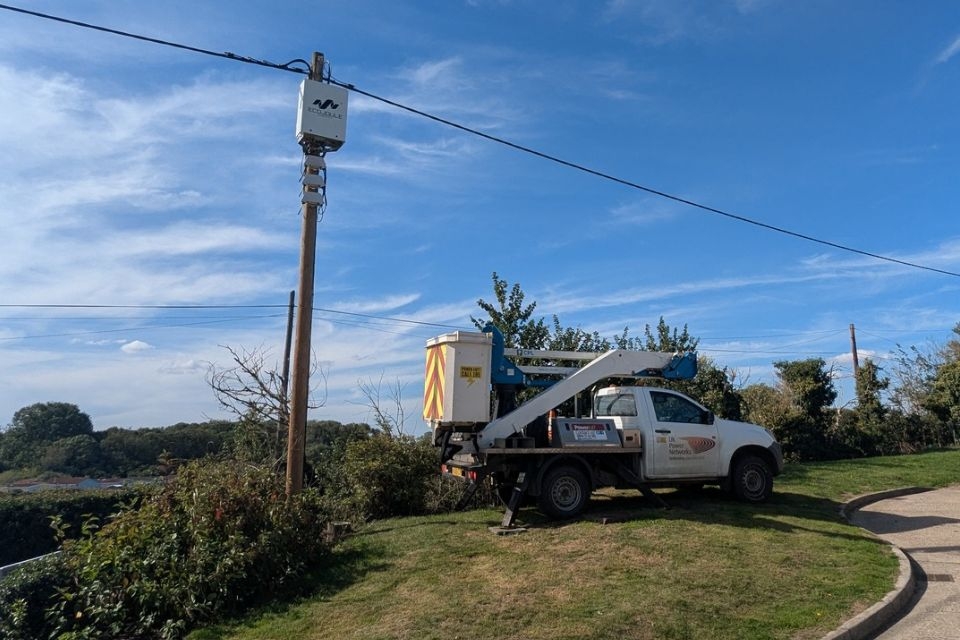
EcoJoule has started trialling its EcoVAR Static Compensator with UK Power Networks.
UK trade agreement aids expansion
With major tenders on the immediate horizon, EcoJoule is set to benefit directly from the Australia-UK Free Trade Agreement (A-UKFTA). The agreement removed tariffs on all electrical and power-related industrial equipment when it entered into force in 2023.
Critically, the agreement included generous rules of origin provisions. This means companies in Australia and the UK can import electrical components from third-party countries, and their products still qualify for the zero-tariff rate.
‘The trade agreement makes us highly competitive in the UK,’ says van der Linde. ‘We can market our technology based on technical merit and we don’t have to compete on anything else.
‘As we expand, we will send engineers over to the UK to train engineering teams and help with commissioning,’ he adds. ‘We anticipate hiring in the UK and working with a local distributor.’
By October 2026, EcoJoule had begun shipping compensators to multiple power utilities in the UK.
The future Australia-EU FTA expands export opportunities
EcoJoule believes Europe will also become a major new export market. This is because the company’s technology is particularly suited to the specific challenges facing local power networks in Europe.
‘In Eastern Europe, the main challenge for low-voltage networks is integrating domestic solar into local grids,’ says van der Linde. ‘That’s exactly the challenge our technology was built to solve. We have a headstart and can empower householders in Europe to make contributions to their grid.
‘In Western Europe, the challenge is more related to heat pumps,’ he says. ‘These cause undervoltage on low-voltage networks. Heat pumps also introduce anomalies in low-voltage networks – called harmonics – but our compensators provide a practical, low-cost solution to both problems. In combination, this means Europe should become a huge, new market for us.’
Anticipating growth, the company is already conducting trials with power utilities in Romania and Portugal, and the company has installed compensators in Belgium. The company has also won tenders in Moldova, with equipment set to ship at the end of 2026.
‘The FTA with Europe means we can take technology developed here in Australia and help utilities in Europe adapt to net zero,’ says van der Linde.
Go further, faster with Austrade
Austrade’s Go Global Toolkit helps you learn the export basics, find the right markets and understand market requirements.