For Australian businesses experiencing supply chain volatility and disruptions, visit the Go Global Toolkit for the latest updates and support available.
A recent horticulture trade mission brought together peak industry bodies and exporters for an eight-day, four-city program backed by the Accessing New Markets Initiative.
The mission was the largest multi-industry Australian horticulture delegation to visit some of China’s key inland cities. Running from 26 July to 1 August 2026, it allowed Australian horticulture exporters to strengthen links with buyers, distributors and partners across China.
Delivered under ANMI, the mission was led by Trade Diversification Network member the Australian Table Grape Association (ATGA) on behalf of the broader horticulture sector. The cross-regional program visited Kunming, Chongqing, Changsha and Qingdao.
Nine peak horticulture bodies, Hort Innovation and 11 exporters across key fresh produce categories travelled to the 4 cities. The program was designed to help exporters strengthen ties in established coastal markets while developing relationships in emerging Tier 2 and regional centres.
Austrade’s China team supported the visit through stakeholder coordination, market briefings, business matching and practical in-market facilitation across the three regions.
Growing demand for imported fruit in regional cities
The program helped exporters develop a deeper understanding of market opportunities, distribution models and retail channels in China’s tier-2 cities, where demand for premium imported fruit is growing fastest and Australian product remains under-represented.
Australian horticulture exports are forecast to reach A$4.7 billion in 2025–26, up 8% year on year. China is the largest single-country market for Australian fresh fruit. Table grape exports reached A$485.8 million, with China now the second largest export market. Australia’s counter-seasonal supply window peaks between February and April, when Chinese domestic supply is lowest. This positions Australian growers as a natural premium partner for China’s inland consumer markets.
‘Direct engagement across 4 cities gave exporters a clearer understanding of consumer preferences, sales channels and regional market dynamics,’ says Martin Ferreyra, Trade and Investment Commissioner, Austrade.
‘The mission demonstrates why diversification within China matters. Looking beyond Beijing, Shanghai and Guangzhou is not only a risk management strategy. It is a practical way to build new commercial pathways in under-served markets with growing demand for premium Australian produce.’
MOU establishes platform for future cooperation
In Kunming, delegates explored opportunities linked to Yunnan’s role as a gateway connecting Southwest China with Southeast Asia. A highlight of the program was the signing of a memorandum of understanding with Kunming Haiguanxing Wholesale Market, representing a new strategic channel for premium Australian produce into southwest China.
Chongqing emerged as one of the program’s standout markets. As one of China’s largest consumer markets and a key inland distribution hub, the city offers significant opportunities for premium imported fresh produce. Delegates engaged directly with importers, distributors and market operators. These included visits and briefings supported by:
- Chongqing Shuangfu International Agricultural Product Trade City, a major wholesale market platform connecting Chongqing-based fruit importers and regional distribution channels
- Chongqing Jinguoyuan, a leading fruit importer and key buyer of Australian table grapes and citrus in West China.
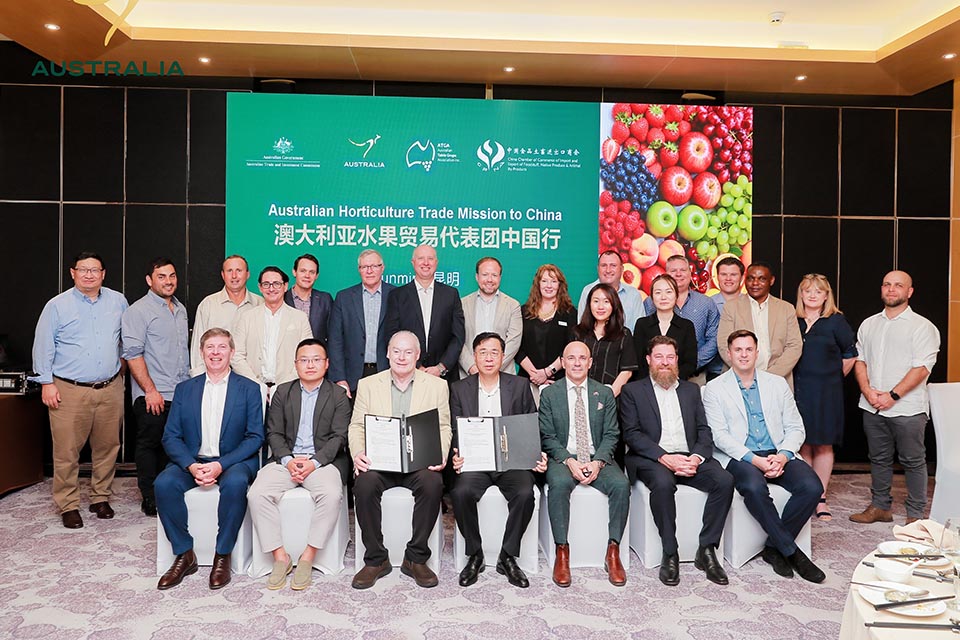
The delegation at the signing of the MOU with Kunming Haiguanxing Wholesale Market.
Exploring the potential of China’s regional markets
The mission also visited Changsha in South China and Qingdao in North China, giving delegates a broader view of regional demand across China’s major consumption corridors. Delegates met with wholesale market operators, importers, retailers and logistics stakeholders to better understand local consumer preferences, distribution networks and market entry opportunities in each region.
Initial feedback from participants highlighted the value of the coordinated, multi-sector and multi-region approach. By bringing together table grapes, citrus, summerfruit, cherries, berries, avocados, melons, mangoes and dried fruits across South, Southwest and North China, the mission gave Chinese stakeholders a more integrated view of Australia’s premium horticulture capability. It also enabled peak bodies and exporters to exchange market intelligence across categories and regions, strengthening the industry-wide value of the program.
‘This program demonstrated the growing potential of China’s regional markets for Australian horticulture exporters,’ says Jeff Scott, CEO of the Australian Table Grape Association. ‘Bringing together multiple industry sectors enabled delegates to build valuable relationships, exchange market intelligence and identify opportunities beyond traditional coastal markets.’
ANMI support for ongoing collaboration and initiatives
The mission will be followed by targeted buyer follow-up, exporter-specific introductions and continued collaboration with ATGA, participating peak bodies and Hort Innovation.
Upcoming ANMI-supported horticulture initiatives in the Mainland China, Hong Kong and Taiwan region include:
- China International Fruit Expo in Shanghai (26 to 28 August 2026)
- Asia Fruit Logistica in Hong Kong (2 to 4 September 2026)
- an apple launch event at the Ambassador’s Residence in Beijing on 4 September 2026
- Australian Macadamia Society trade seminars in Taiwan and Shanghai
- a Hong Kong cherries retail promotion
- In-season market intelligence project, gathering market insights from the ground to support commercial decision-making.
These activities will help maintain a sustained engagement in the horticulture sector and reinforce Australia’s premium fresh produce positioning across China and the broader region.
Go further, faster with Austrade
Austrade’s Go Global Toolkit helps you learn the export basics, find the right markets and understand market requirements.