For Australian businesses experiencing supply chain volatility and disruptions, visit the Go Global Toolkit for the latest updates and support available.
Intermodal Solutions Group (ISG) is turning Australian container technology into a new global benchmark. The company’s ‘pit-to-ship’ solution has enabled Chile to build the world’s first, fully automated copper-concentrate export facility.
ISG’s solution means hazardous concentrates can travel in sealed containers from mine site to cargo ship. This prevents toxic dust from contaminating the environment. Designed and engineered in Australia, ISG containers are now used globally, including in Mexico, Peru and India.
‘By keeping bulk goods containerised, we can clean up quays and ports worldwide,’ says Garry Pinder, Managing Director, ISG. ‘That’s a big win for the air we breathe and the seas we fish in.’
Australia takes containers to the next level
ISG was founded in 2005 to make freight containers for Australia’s general freight and mining industry.
‘At that time, transporting mineral concentrates was often hazardous,’ says Pinder. ‘Copper concentrate is toxic but was stored in the open at ports, ready for loading into bulk carriers. High winds meant waste and health and safety risks as the concentrate was blowing into the ocean and surrounding areas.’
ISG designed a new type of hermetically sealed container that can be rotated during lifting. By transporting bulk goods in air-tight containers, customers can reduce waste and pollution.
‘Today, we are a global company with 38,000 containers in operation,’ says Pinder. ‘We operate with grain and sugar traders in Argentina, urea in Bolivia and Brunei, and the copper industry in Chile, Mexico, the US and Canada.
‘A large amount of the world’s copper concentrate is moved from mine site to the port in ISG rotating containers.
‘We are based in Australia and most of our design and engineering is done here.’
The ‘pit-to-ship’ solution
ISG has evolved from a company that supplies containers to a company that supplies transport solutions.
The company’s ‘pit-to-ship’ model means ISG supplies a logistics, storage and ship-loading solution.
‘Customers like our ‘pit-to-ship’ model because it reduces loss. They know their goods will be stored safely and transported in the most environmentally friendly way possible.’
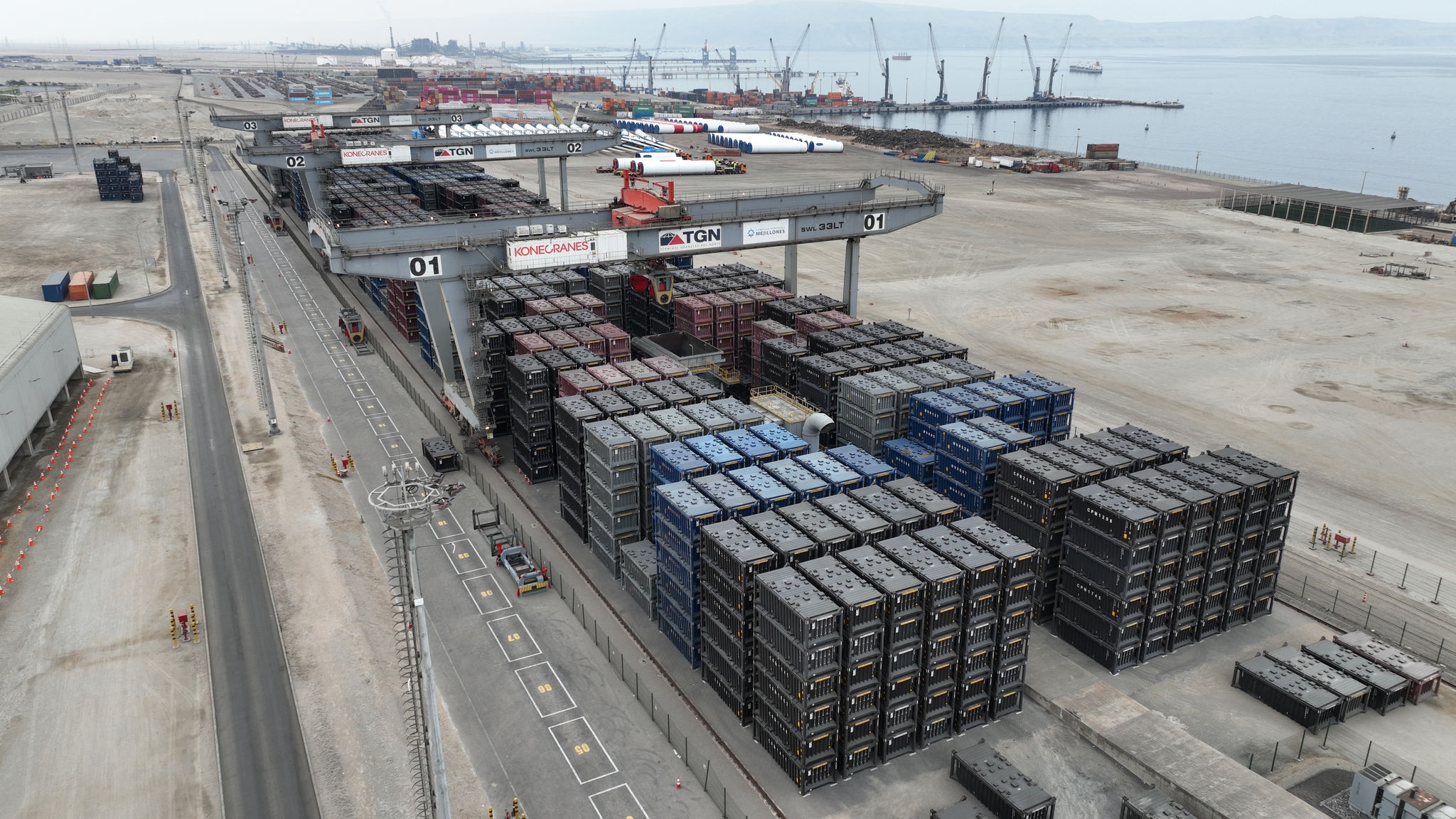
ISG’s air-tight containers allow customers to transport commodities from site to ship, preventing waste and improving worker health and safety.
Contributing to the world’s first automated bulk terminal
By re-thinking container processes, ISG has helped create a true, global first.
‘Our pit-to-ship technology has evolved to the point where we have just contributed to the world’s first, fully automated shipping port for concentrates,’ says Pinder.
Puerto TGN in Antofogasta, Chile became operational mid-2025.
‘This port will now become a global benchmark for environmentally sound port solutions,’ he adds. ‘The port demonstrates how amazing logistics, storage and ship-loading technology can become a new global standard.
‘The main feature of the operation is the ISG rotating containers and our lid-lifting patent for the tipplers (handling machinery). Both were invented here in Australia.
‘There is zero product loss between the mine site and the ship as the containers are used as storage sheds. There is no double handling.’
Export success in Mexico, Peru and India
ISG is a global showcase for great Australian technology. Its containers and solutions are being adopted around the world.
‘Before we went to Chile in 2014, copper concentrate was being transported by open trucks and stored on quay sides,’ says Pinder. ‘By sealing concentrate in containers, we have drastically reduced waste and pollution. Today, we have 16,000 containers working in the Chilean copper industry.’
Other export customers include Mexico and India.
‘I went on a mission to Mexico with Austrade in 2017 and over the past 5 years we have sold our pit-to-ship solution into 3 ports. In total, we have sold 3,000 containers to customers in Mexico.
‘In 2024, we went to India and ISG is now working with the Adani company. In Peru, we supplied 3,000 of our rotating container fleet into the Las Bambas mine, which is one of the world’s biggest copper projects.’
How Austrade helped
Pinder says Austrade always helps his company explore new markets.
‘The first thing I do when I go to a new country is to contact the local Austrade Business Development Manager (BDM),’ he says. ‘The BDM gives me the lay of the land and tells me who is doing what in terms of commodities logistics.
‘I have worked with the Austrade BDM in Chile, Valeria Ortiz, for more than 10 years, as well as the BDM in Peru Valeria Beck. They have both helped us out immensely. They open doors and make introductions – and they really know the industry.’
Top tips for exporters
- If I were a new exporter, the first thing I would do is go to Austrade, speak to the BDM and get the lay of the land. Austrade advisers are a wealth of knowledge.
- If Austrade has a stand, get a booth on it. Australia is renowned for its mining expertise and people come to the stand to see what’s available.
- Seek out other Australian exporters at exhibition stands and find out the dos and don’ts.
Go further, faster with Austrade
Austrade’s Go Global Toolkit helps you learn the export basics, find the right markets and understand market requirements.