For Australian businesses experiencing supply chain volatility and disruptions, visit the Go Global Toolkit for the latest updates and support available.
India can be a challenging market for global food and beverage brands. Tastes are evolving, however, and one company that’s taking advantage is Australia’s soft-serve supremo, Frosty Boy.
With the help of Indian partners and local manufacturing, Frosty Boy has developed new pathways to market and is now enjoying double-digit growth.
‘We have built real trust for our products in India,’ says Steve Adams, Managing Director, Kent Worldwide, Asia-Pacific. ‘India has a strong dairy heritage and incredibly talented people. We aren’t just growing quickly in India, we see India as a future regional hub for our business.’
Serving Australian ice cream worldwide
The Frosty Boy soft-serve ice cream brand was founded in Queensland, in 1976. The company sells into quick service restaurants (QSRs), retail outlets and cafes, and has established a reputation as a leading innovator in desserts and beverages.
The company is also a leading exporter. Its products sell in more than 10,000 customer outlets across the world, from developed markets like the US to emerging markets in Asia and Africa. In 2023, Frosty Boy became part of Kent Worldwide, a family-owned business from Muscatine, Iowa.
‘Frosty Boy exports have grown at more than 16% annually over the last decade,’ says Adams. ‘We continue to open new markets and today, you can buy Frost Boy soft serve in 76 countries.’
Overcoming initial market challenges
Frosty Boy first entered the Indian market in 2017 – and had to overcome multiple challenges.
‘It was hard going for us to begin with,’ says Adams. ‘Then the pandemic hit in 2020 and that stymied our ability to grow. We only gained real momentum in 2022, but since then we have seen significant year-on-year growth.’
The company uses a mix of ingredients from India, Australia and elsewhere for its innovative dessert and beverage blends.
‘Today, we primarily work with Tier 1 and Tier 2 QSR brands and retail brands,’ says Adams. ‘In effect, we export Australian IP and our soft serve expertise to India, and business is growing fast.’
Western food brands gaining popularity
For Frosty Boy, India’s attractiveness is linked to 2 factors: increasing prosperity and new retail trends.
‘The middle class is growing rapidly in India, and we see an increase in Western trends in F&B [food and beverage],’ says Adams. ‘The growth in Western-style QSRs creates opportunities for us in soft-serve.
‘The second factor is the emergence of Western-style supermarkets across India. This is an unusual market entry point for us, but we have established a relationship with India’s largest supermarket chain, and that has generated significant growth.’
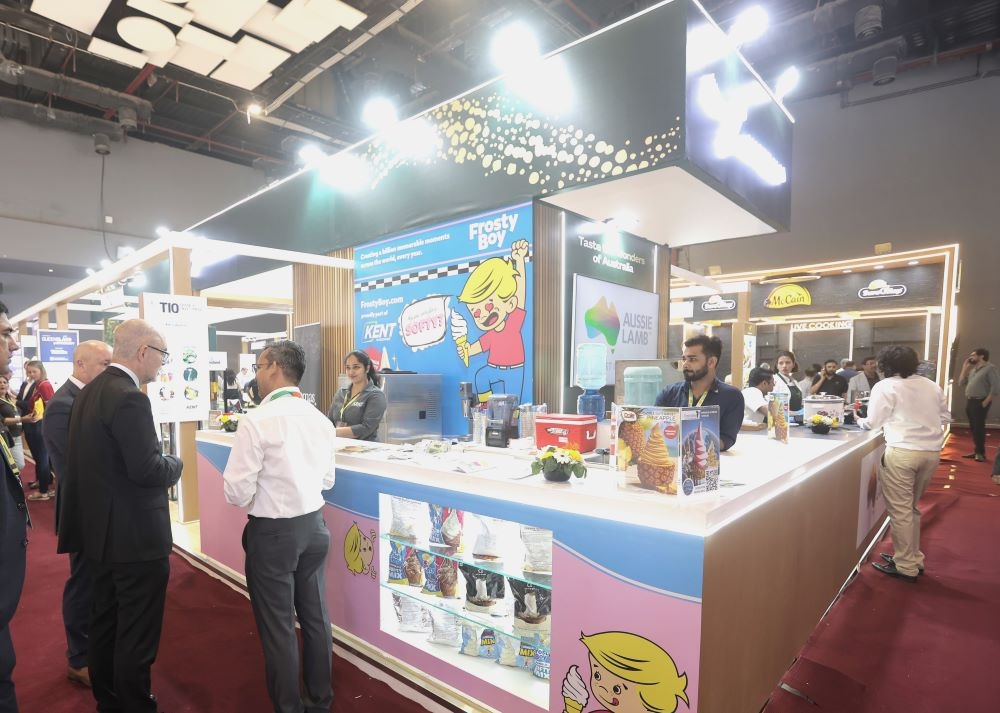
Trade shows have been a great way for Frosty Boy to connect with potential customers.
Determination delivers dividends
Adams points to numerous challenges for Western food brands trying to sell in India – but says his company’s growth shows success is possible.
‘Pricing is a real challenge for Western food brands, because we are selling high-value goods into a very competitive market,’ he says. ‘We have to work around multiple import challenges and still offer a competitive product. However, the Australia-India Comprehensive Economic Partnership Agreement (AI-ECTA) is making imports easier, year by year.’
Adams also advises working with local partners to manage supply chain issues.
‘India can be incredibly complex, with tough supply chain challenges in terms of getting product to all the states and cities,’ he says.
‘To overcome this, we work with a partner in India that manages in-market manufacturing. Localised production means we can be more responsive to customers. We can develop localised flavours, so we build a much better product range.
‘Building a robust supply chain in India is critical.’
Partnering and product quality
One critical factor is the quest to maintain quality.
‘We ensure our customers have the right equipment and training,’ says Adams. ‘This is because we need to ensure that quality standards are exceptional.
‘Another “must” is to acquire in-market talent in our sales, R&D and supply chain teams. We have invested heavily in recruiting people with significant local market knowledge.’
Adams also says that finding the right partners can help overseas companies navigate India’s tax and legal systems – which he says can be highly complex.
‘We are very lucky with our local partner, and cannot speak highly enough of them,’ he says.
Making connections at trade shows
Food trade shows provide a great entry point for potential exporters, according to Adams.
‘We attend trade shows in India, where we work in parallel with Austrade,’ he says. ‘This is a great way for us to connect with the Austrade advisers and to support their work.
‘By attending trade shows, potential customers get to taste our products, and we show them our commitment to India. Frosty Boy is still a relatively new brand in the market, so trade shows are a great way to build our brand.’
Adams credits Austrade with helping Frosty Boy find and develop commercial partnerships.
‘Austrade bought us a seat at the table when we were setting up here in India,’ he says. ‘They made connections and opened doors in ways we could not have arranged by ourselves.
‘The credibility and trust we derive from Austrade has helped us establish our brand in India.’
Go further, faster with Austrade
Austrade’s Go Global Toolkit helps you learn the export basics, find the right markets and understand market requirements.