For Australian businesses experiencing supply chain volatility and disruptions, visit the Go Global Toolkit for the latest updates and support available.
Australian institutional investors are taking a closer look at Southeast Asia as they seek diversified, long-term opportunities in one of the world’s most dynamic regions.
In October 2026, Austrade led an Australian Institutional Investment Mission to Thailand, bringing more than 20 Australian delegates to the 2026 Annual Meetings of the International Monetary Fund and the World Bank Group in Bangkok.
The delegation included senior representatives from superannuation funds, asset managers, financial institutions and industry bodies, representing a combined capital of more than A$2 trillion.
The mission formed part of Australia’s work to implement Invested: Australia’s Southeast Asia Economic Strategy to 2040. It was designed to build investor capability, deepen regional networks and help Australian capital allocators assess opportunities with clearer insight into local market settings, risk and partnership models.
Why Southeast Asia is drawing investor attention
Southeast Asia’s long-term growth, infrastructure needs and energy transition are creating a substantial investment task. The region’s infrastructure needs are expected to exceed A$3 trillion by 2040, while renewable energy, storage, grids and enabling infrastructure are opening new areas of demand.
For Australian investors, this presents a diversification opportunity. Australia has one of the world’s largest pools of retirement savings, which could potentially be invested in Southeast Asia, a region that remains comparatively under-represented in outbound investment.
Association of Superannuation Funds of Australia Chief Strategy and Corporate Affairs Officer Madeleine Morris says around half of Australian superannuation money is now invested overseas, making deeper regional understanding increasingly important.
‘Southeast Asia is only growing in its importance as a regional bloc, as a diverse group of countries and as a real financial driver,’ Morris says.
Thailand as a gateway to regional opportunity
Thailand was a strategic setting for the mission. It offers established industries, strong regional connectivity and ambitions for future infrastructure and economic development. Meetings in Bangkok enabled delegates to examine both Thailand-specific opportunities and wider Southeast Asian investment themes.
The program included briefings with Australian Government representatives, global financial institutions, multilateral organisations and leading regional companies. Delegates engaged with senior leaders from government, finance, infrastructure, energy and real estate, including high-level engagements with the Prime Minister of Thailand Anutin Charnvirakul and the Treasurer of Australia Dr Jim Chalmers.
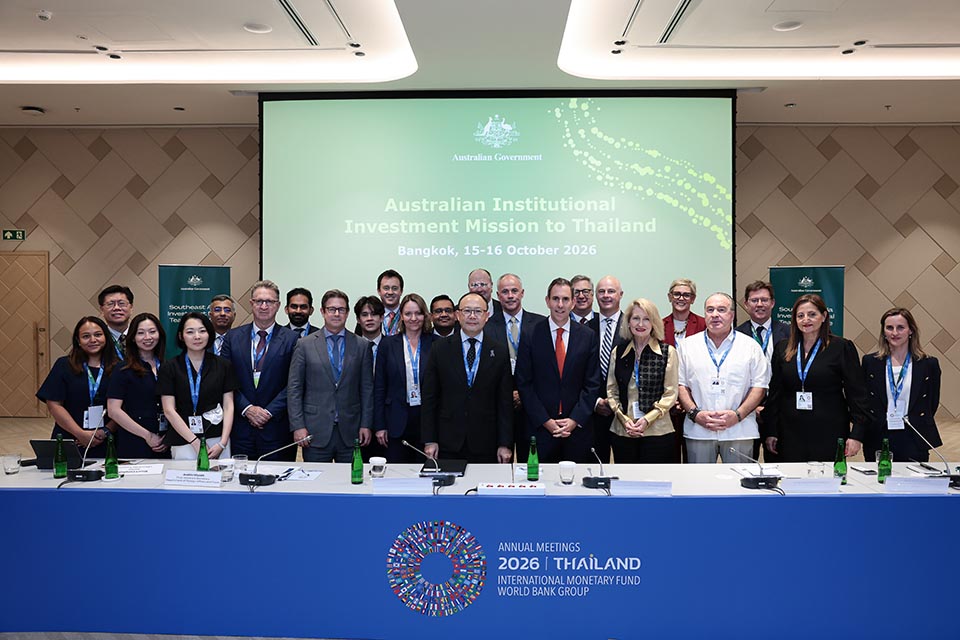
Australian Treasurer Jim Chalmers (5th from right) joined Australian Ambassador to Thailand Pablo Kang and the delegation for an investment roundtable as part of the mission program.
From market interest to informed action
Head of Austrade Southeast Asia Catherine Gallagher says the opportunity cannot be assessed through a broad regional lens alone.
‘Each investment must stand on its own fundamentals, including scale, governance and risk allocation, and it needs to fit with the investor’s mandate,’ Gallagher says.
Gallagher says the mission’s direct exposure to markets and access to government, industry and potential partners gave delegates a practical opportunity to test assumptions, understand local conditions and risks, and identify credible alignment with investment mandates.
What matters to investors
Across the mission, delegates emphasised that successful long-term allocations require more than capital. Trusted local partners, credible counterparties, transparent governance and clear risk allocation will help investors conduct due diligence, navigate market settings and progress opportunities.
Plenary Group Director, Origination Oliver Redrup says public infrastructure investment depends on effective project preparation, transparent procurement and appropriate risk-sharing between the public and private sectors.
‘It’s very important to engage extensively with government to understand the regulatory framework and the projects coming to market, but also to engage with local partners in the supply chain,’ Redrup says.
Read a case study on Plenary Group’s investment in Southeast Asia.
Investor Deal Teams build investors pathways
Austrade, together with the Department of Foreign Affairs and Trade and Export Finance Australia, leads the Southeast Asia Investment Deal Teams. The teams work with market specialists to support investors – providing market insights, facilitating trusted relationships and helping identify suitable opportunities over time. The teams also work with businesses, project proponents, financiers and government agencies across the region to connect Australian capital with credible opportunities.
The Investment Deal Teams also help investors understand risk mitigation and blended-finance mechanisms. Origination, co-investment, syndication and blended finance can create pathways for institutional investors to participate in emerging-market opportunities that may otherwise be difficult to access at scale.
Looking ahead
The mission reinforced that Southeast Asia’s investment opportunity is significant, but not generic. Foresight Group Director Peter McGregor says the region is made up of distinct economies, each with its own jurisdiction, legal system and culture.
‘Coming to Bangkok and Thailand more generally is an opportunity for delegates to dive deeper into the specific opportunities and the specific environment for investment here,’ McGregor says.
By bringing together institutional investors, industry, government and multilateral partners, the mission helped deepen the relationships and market understanding needed to support long-term investment. It also demonstrated how Australia can work with Thailand and Southeast Asia to strengthen economic cooperation and support sustainable, resilient growth.
Sign up to receive the latest news and insights about Southeast Asia.
Go further, faster with Austrade
Austrade can help Australian businesses to explore investment opportunities in Southeast Asia.