For Australian businesses experiencing supply chain volatility and disruptions, visit the Go Global Toolkit for the latest updates and support available.
Founded in 2016 and listed on the ASX in 2018, DXN designs, engineers, manufactures, deploys, operates and maintains prefabricated modular data centre infrastructure. The company has established itself as a one-stop-shop for mission-critical infrastructure across the Asia-Pacific region, with nearly 100 data centres delivered.
With approximately 80% of its revenue generated from export markets in FY2024–25, international growth is not a future ambition for DXN, it is core to business growth. Increasingly, Southeast Asia is a key component of that growth.
A region ready for modular infrastructure
Southeast Asia is one of the world’s fastest-growing digital economies. The region is projected to become the world’s fourth largest economy by 2040, with a young population, rising middle class and rapid urbanisation driving demand across digital technology and infrastructure. For a company whose core product is a flexible, scalable, rapidly deployable data centre solution, the strategic logic for expansion in the region was clear.
DXN’s decision to deepen its presence in Southeast Asia was driven by two converging forces: the structural fit between DXN’s modular offering with the region’s infrastructure needs, and the accelerating global demand for distributed, edge and cloud-adjacent data centre capacity.
‘Southeast Asia isn’t just a growth opportunity – it’s a structural fit,’ says Shalini Lagrutta, CEO and Managing Director of DXN. ‘The region’s digital infrastructure is being built right now, and prefabricated modular data centres is exactly the right solution for markets that need speed, flexibility and cost efficiency. We didn’t want to watch that wave from the sidelines.’
Indonesia quickly emerged as the preferred entry point into the region. Import tariffs on data centre products typically run at 20% to 40%, making local manufacturing capability more attractive than exporting finished units. DXN’s partner-led entry strategy – anchored by a non-binding MoU with local firm Super Sistem Indonesia (SSI) – was designed to unlock this advantage from the outset.
The company also identified strong opportunities in the Sijori corridor — the Singapore–Johor–Riau triangle — where data centre construction is accelerating. With existing customer relationships in the region and a supportive investment environment in Malaysia, Johor emerged as a natural base for DXN’s next manufacturing presence.
A deliberate, partner-led entry
Rather than committing large amounts of capital from day one, DXN took a staged approach to building its Southeast Asian presence. It validated the market opportunity, secured a local partner, and designed a structure that would allow for delivery at scale.
The pathway into Indonesia required a Singapore-based joint venture, with equal ownership between DXN and SSI, that would establish a jointly owned manufacturing facility in Jakarta and support future purchase orders. This structure is designed to give DXN local responsiveness and compliance advantages, while maintaining the engineering quality and delivery discipline that differentiates the Australian business.
‘We combined market selection, partner-led entry and a localisation plan so we could serve customers with speed, compliance and cost competitiveness,’ explains Shalini.
The company’s early steps are already paying off. The partnership with SSI is expected to bring in approximately US$7 million in revenue over the next three years, with scope for more work beyond the initial demand, including additional project and manufacturing work.
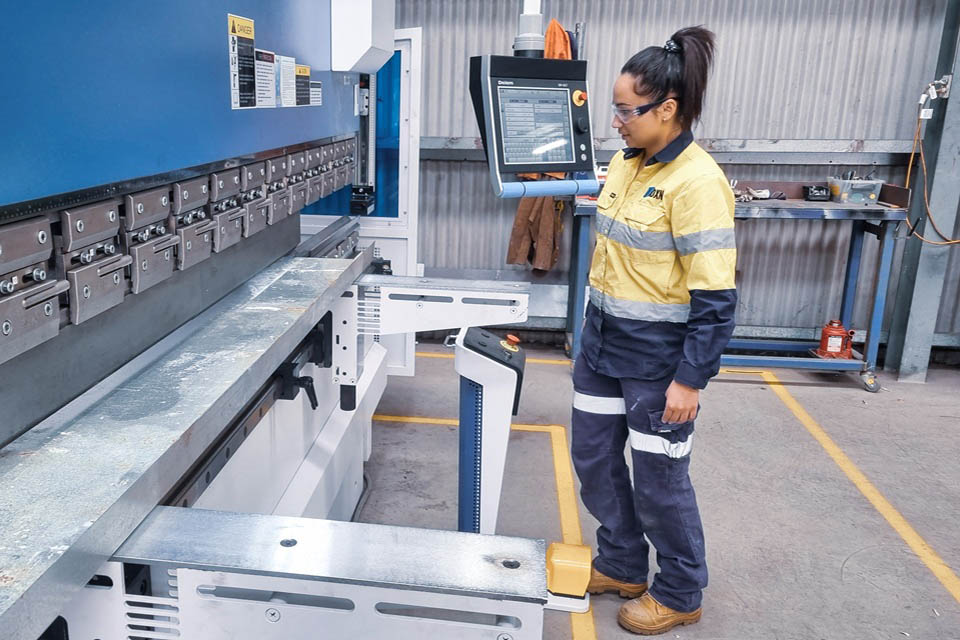
DXN has partnered with an Indonesian firm to start manufacturing data centre products in Jakarta.
Southeast Asia Investment Deal Teams: reducing friction in-market
DXN worked closely with the Southeast Asia Investment Deal Teams – a joint initiative of Austrade, the Department of Foreign Affairs and Trade and Export Finance Australia – to navigate the complexities of establishing a presence in an unfamiliar market.
Shalini explains that ‘they helped reduce friction in-market – connecting us to the right conversations earlier, and supporting the practical steps needed to establish an investment footprint. Austrade was also valuable and hugely supportive on day-to-day support and high-quality introductions to partners.’
For businesses entering Southeast Asia, this kind of on-the-ground support can reduce the time and cost of market entry by helping to identify and connect with the right commercial partners and relevant officials faster.
Benefits flowing back to Australia
DXN’s Southeast Asian strategy is not a pivot away from Australia: it is an amplification of the Australian business. The company’s data centre operations in Darwin and Hobart, engineering and manufacturing capability in Sydney and Perth, and its corporate functions all remain anchored onshore.
As DXN scales regionally, growth in Southeast Asia creates more demand for Australian expertise: high-value design, program delivery, engineering leadership and the operational know-how built over nearly a decade of mission-critical deployments. The international revenue base also supports investment in new offerings, including the recently launched Data Centre as a Service (DCaaS) model, which adds a recurring revenue stream to the business.
‘Every project we deliver either in Southeast Asia or other export markets make the Australian business stronger,’ says Shalini. ‘We’re investing in our teams in Australia, developing new service models like DCaaS, which is a progression of the project-based sales that we currently do.
‘These investments simply wouldn’t be viable without an international revenue base to underpin them. This isn’t growth at the expense of Australia; it’s growth because of it.’
Australia’s economic relationship with Southeast Asia is already substantial. Australia’s two-way trade with ASEAN totalled A$197.4 billion in 2025, and two-way investment stock reached A$296.2 billion. Companies like DXN play a practical role in deepening this relationship, bringing trusted Australian engineering and delivery capability into the region.
Looking ahead
DXN’s short-term focus is on execution. This means converting the SSI MoU into a functioning joint venture, establishing the Jakarta manufacturing facility, and building repeatable operational capability across Southeast Asia. The company is also watching developments in Johor closely, where the data centre build-out continues to accelerate.
‘Our next step is disciplined execution: converting strategic progress into delivered projects, building repeatable operating capability in-market, and scaling our model across Southeast Asia without losing what differentiates DXN – quality, speed and end-to-end accountability,’ says Shalini. ‘Southeast Asia is not a monolith. Each market has its own regulatory settings, cost structures and partnership norms.’
For other Australian businesses weighing a move into Southeast Asia, DXN’s experience points to three practical principles. First, develop a specific ‘why this market, why now’ thesis linked to a concrete execution pathway. Second, invest early in trusted networks and on-the-ground validation, and engage government facilitation where it is available. Third, design an operating model that preserves Australian capability while building genuine local responsiveness.
Sign up to receive the latest news and insights about Southeast Asia.
Go further, faster with Austrade
Austrade can help Australian businesses to explore investment opportunities in Southeast Asia.