For Australian businesses experiencing supply chain volatility and disruptions, visit the Go Global Toolkit for the latest updates and support available.
Singapore’s AI market is shifting from experimentation to enterprise deployment. Organisations are seeking solutions that address defined business problems, integrate securely with existing systems and deliver measurable value.
Against this backdrop, Austrade and Trade Diversification Network (TDN) member Tech Council of Australia brought 24 Australian AI companies to Singapore to test commercial opportunities and connect with prospective customers, partners and industry stakeholders.
The Australian AI Innovators Mission ran from 28 to 30 September 2026 with support from the Accessing New Markets Initiative.
What it takes to put AI to work
The AI Transformation Forum on 28 September brought together government and industry leaders to examine how organisations can turn AI ambition into measurable business outcomes.
Discussions identified four requirements for deployment at scale:
- clear business priorities
- leadership commitment
- workforce capability
- trusted data and governance foundations.
Speakers emphasised that organisations should begin with a defined operational problem rather than adopt AI for its own sake and embed effective solutions in day-to-day operations.
The forum featured perspectives from AI Singapore, OpenAI, Google Cloud, Mastercard and SJ Group, alongside Australian companies from across the AI value chain. Data Centres Australia and Google Cloud facilitated industry discussions on the capabilities required for trusted AI adoption at scale.
Australia’s Deputy High Commissioner to Singapore, Emily Follett, opened the forum, with contributions from Dr Kate Cornick, Chief Executive Officer of the Tech Council of Australia and Austrade Chief Information and Digital Officer Radi Kovacevic.
‘For some companies, this is their first entry into the Asian market,’ says Dr Cornick. ‘Others are looking to grow their existing footprint. Regardless of where they are on that journey, Singapore offers enormous opportunities for Australian tech companies as a landing pad into Asia.’
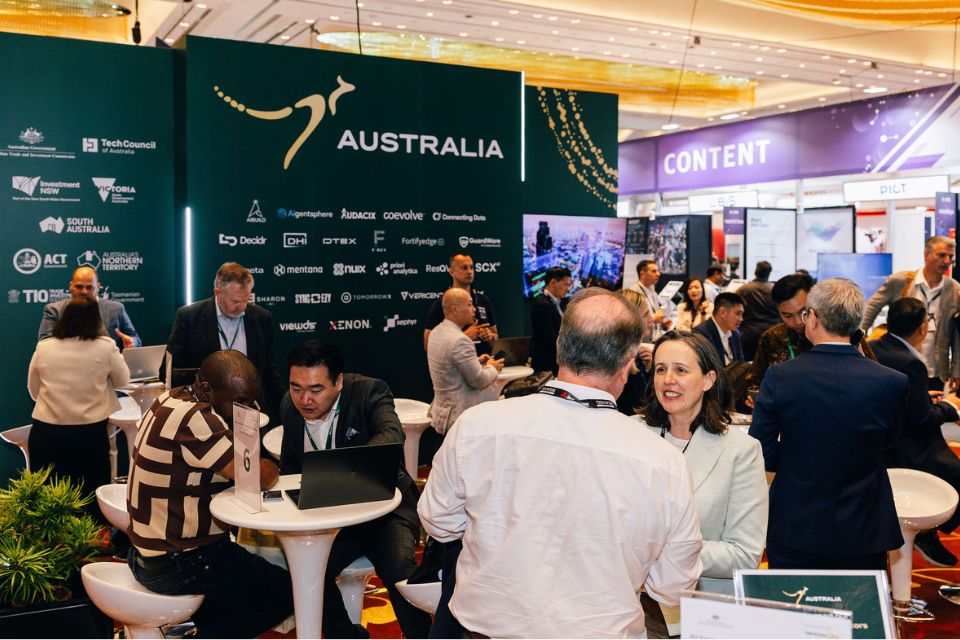
Australian AI companies explore opportunities and make new connections at the Team Australia pavilion at Tech Week Singapore.
What the market told us
Across the mission, delegates held more than 100 engagements with prospective customers, partners and industry stakeholders, including more than 60 scheduled business-matching meetings. Further discussions took place through the AI Transformation Forum, the Team Australia pavilion and Singapore Tech Week activities.
Three market signals emerged. First, organisations are moving from experimentation to deployment, prioritising measurable value in areas such as automation, compliance and operational efficiency.
Second, trust, governance and security remain central to adoption, particularly data quality, accountability, explainability and secure deployment.
Third, demand is increasing for enabling infrastructure, including compute capacity and sovereign cloud services.
‘The advantage of AI will come from the effectiveness of its deployment, not from access,’ says Tsubasa Bolt, Deputy Director, Sustainable Assets and Climate Solutions, SJ Group.
For Australian companies, these signals point to opportunities for AI solutions with trusted foundations designed around clearly defined business needs.
Australian AI in action
At the Team Australia pavilion at Tech Week Singapore, Austrade, Tech Council of Australia, and state and territory partners supported Australian delegates to engage with potential customers and partners, exploring how their solutions meet market needs.
The delegation represented capabilities across the AI value chain, including digital infrastructure and compute, enterprise and agentic AI, governance, cyber security and sector-specific applications.
Sharon AI, SCX.ai and XENON Systems presented capabilities in AI infrastructure, compute and secure deployment. Nuix, DTEX, Vericent, IDmeta and ViewDS demonstrated solutions in governance, compliance, risk management and digital trust.
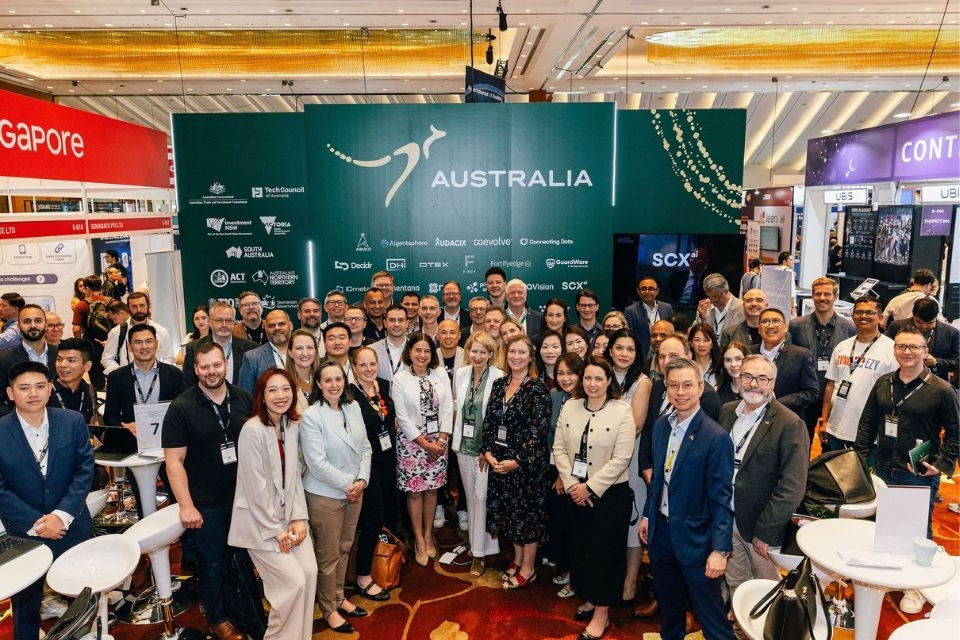
Second from inner left: Dr Kate Cornick, CEO of Tech Council of Australia; Dr Kathy Nicholson Institute Manager of AIML; Australian High Commissioner to Singapore H.E. Robyn Mudie; Catherine Gallagher, Head of Austrade Southeast Asia; Amelia Walsh, Senior Trade and Investment Commissioner for Singapore, regional Austrade staff, state and territory partners and Australian delegates.
Mentana, Priori Analytica, FortifyEdge and ResQVision showed how AI can address operational challenges across supply chains, agribusiness, critical infrastructure, energy optimisation, public safety and industrial operations.
The delegates demonstrated Australian capability in two areas of growing regional demand: the trusted foundations needed to deploy AI and the practical applications that address defined operational problems.
‘Customers are looking for solutions built around a defined use case, supported by partners who understand the local market. The business-matching helped us identify several potential partners, and our next step is to continue those discussions and assess where there is the strongest fit,’ says Kenn Rodrigues, Co-founder and CEO of DHI.
For more information on Australian capabilities across the AI sector, see the Australian AI Industry Capability report.
Building regional pathways
The mission was one step in building longer-term commercial engagement across Southeast Asia. Singapore provides Australian technology companies with access to regional customers and partners, while Austrade’s Landing Pads program and sector-focused trade missions offer further pathways into Southeast Asian markets.
‘Trade diversification is about helping Australian companies turn initial market engagement into long-term commercial pathways across Southeast Asia,’ says Catherine Gallagher, Head of Austrade Southeast Asia.
‘Following Tech Week Singapore, the next major opportunity is Singapore FinTech Festival in November, where Australian fintech, regtech and cybertech companies can build regional partnerships and pursue growth.’
For more information on the Team Australia Mission to Singapore FinTech Festival, contact Winnie Wang, Regional Fintech Director, Austrade.
Go further, faster with Austrade
Austrade’s Go Global Toolkit helps you learn the export basics, find the right markets and understand market requirements.