For Australian businesses experiencing supply chain volatility and disruptions, visit the Go Global Toolkit for the latest updates and support available.
With almost a quarter of the world’s population, diverse, sophisticated markets and dizzying economic growth, South Asia is a region rich with opportunity.
Austrade recently led a series of South Asian export strategy workshops to connect Australian firms with regional growth opportunities in the agribusiness, tech, health, green energy and infrastructure sectors.
The green economy roadshows were delivered in partnership with Trade Diversification Network members Austmine and the Smart Energy Council, states and territories, and the Department of Foreign Affairs and Trade, with support from the Accessing New Markets Initiative and the South Asia Business Exchange.
Murray Spence, Austrade’s South Asia Trade and Investment Commissioner for Green Economy, came to Australia from Bengaluru to lead workshops on green energy, mining technology services and the circular economy.
In this article, Murray shares his insights on the renewable energy sector in South Asia, and what market developments might surprise Australian firms.
South Asia’s renewable energy transformation
South Asia is investing heavily in renewable energy. What’s driving that transformation, and why should Australian businesses be paying attention?
South Asia is home to almost one-quarter of the world’s population, making it one of the largest centres of future energy demand and economic growth.
India alone has emerged as the world’s third-largest renewable energy market. It is expected to account for a significant share of global growth in electricity demand over the coming decades.
The region has now moved beyond the challenge of energy access. The next phase is about integrating renewable energy at scale through storage, transmission, digital utilities, hydrogen and advanced energy management systems. This is precisely where Australian capability is strongest.
Australia’s expertise in grid integration, battery storage, digital utilities, hydrogen pathways, standards and project development aligns closely with the region’s priorities.
The opportunity for Australia is therefore much bigger than exporting equipment. It is about becoming a trusted partner in one of the world’s most significant energy transitions.
Supporting India’s clean energy ambition
India has set a target of 500 GW of non-fossil fuel capacity by 2030. Where do you see the strongest opportunities for Australian companies to contribute?
India’s clean energy ambition is extraordinary. The country has committed to 500 GW of non-fossil fuel electricity capacity by 2030, one of the largest energy transition programs globally.
The first phase of India’s journey focused on adding renewable generation. The second phase is about integrating that generation into a modern, reliable power system. That creates opportunities in battery energy storage systems, grid modernisation, digital energy management, transmission infrastructure, distributed energy resources, hydrogen and critical minerals.
India’s electric vehicle sector is also growing rapidly, placing additional pressure on electricity networks and creating demand for charging infrastructure, energy storage and grid resilience solutions.
Where advanced technology, specialist engineering and operational expertise are required, Australian companies are particularly well positioned. Our value proposition is not competing on cost – but helping solve complex energy-system challenges.
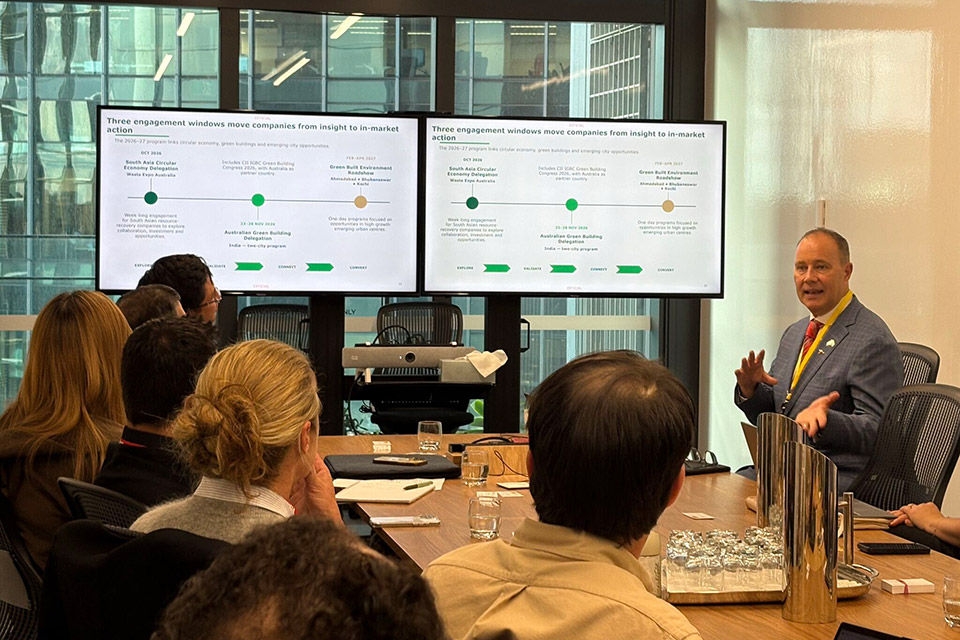
Austrade Trade Commissioner Murray Spence shared insights on the renewable energy sector in South Asia, and the opportunities for Australian businesses.
Different markets, different opportunities
Renewable energy markets across South Asia are diverse. How do opportunities differ between India and neighbouring markets such as Bangladesh or Sri Lanka?
Each South Asian market offers a different opportunity profile.
- India is the scale market. It offers one of the world’s largest renewable energy investment pipelines. It is the natural entry point for companies seeking opportunities in utility-scale renewables, storage, hydrogen, manufacturing partnerships and transmission infrastructure.
- Bangladesh is the urgency market. Renewable energy currently accounts for only around 5.3% of installed electricity capacity, yet the Government is targeting 20% renewable energy by 2030 and 30% by 2040. This creates opportunities in rooftop solar, industrial decarbonisation, storage pilots, grid automation and workforce capability development.
- Sri Lanka is the resilience market. The country is focused on increasing renewable energy penetration, improving grid resilience and strengthening long-term energy security. Australian expertise in specialised grid solutions, storage and technical services is well aligned with these priorities.
The common theme across all 3 markets is the need for trusted partners that can help accelerate the energy transition reliably and sustainably.
Act on opportunities now
For Australian businesses considering South Asia for the first time, what are the biggest misconceptions – or surprises – they’ll encounter?
The most common misconception is that South Asia is a future opportunity. In reality, it’s a current opportunity.
Many Australian companies are surprised by the sophisticated customers, the quality of local innovation ecosystems and the speed at which technologies can scale. India, for example, has one of the world’s most dynamic digital economies and a median age of around 29 years. This has created a large, technology-enabled workforce and consumer base.
Australian businesses are also often surprised by the sheer scale of the market. Whether in renewable energy, digital infrastructure, mobility or manufacturing, South Asia operates at a scale that can fundamentally change the growth trajectory of Australian firms.
A second misconception is that success can be achieved through exports alone. The companies that succeed build local relationships, invest in partnerships and tailor their offerings to local conditions.
Government and industry support for exporters
How can government and industry working together better support exporters to diversify and expand?
Export diversification is most successful when government and industry work as partners.
Government is actively looking to open doors, strengthen economic relationships and reduce barriers to market entry. Through initiatives such as Australia–India Economic Cooperation and Trade Agreement (ECTA), the Australia-India Renewable Energy Partnership, Austrade’s market development programs, trade missions and business-matching services, we help Australian companies connect with the right opportunities and partners.
Industry is bringing innovation, investing in relationships and adapting solutions to local market needs.
A good example is Austrade’s proposed third Clean Energy Delegation to South Asia, covering Dhaka and Delhi between 22–27 October 2026. Market activations like these provide a practical platform for Australian companies to showcase their innovations, meet customers, gain market insights, and identify commercial partners.
The best outcomes occur when government opens doors and industry provides value. Together, we create export success.
Partnerships the key to growth
If Australian exporters take away one message from these workshops, what do you hope it is?
My key message would be simple: South Asia is not just a market to sell into, it’s a market to partner with. Australia brings world-leading innovation, technology, skills and project expertise. South Asia brings scale, investment, talent and implementation capability.
When those strengths come together, the potential is significant. Whether it is renewable energy, batteries, hydrogen, digital utilities or sustainable infrastructure, Australian companies can play a meaningful role in helping South Asia achieve its energy transition ambitions.
The energy transition is one of the largest economic transformations of our generation. South Asia will be a major part of that story and Australian businesses should view the region as a long-term growth partner.
For more information on green energy opportunities in South Asia, contact Austrade.
Go further, faster with Austrade
Austrade’s Go Global Toolkit helps you learn the export basics, find the right markets and understand market requirements.