For Australian businesses experiencing supply chain volatility and disruptions, visit the Go Global Toolkit for the latest updates and support available.
Carbon capture, utilisation and storage (CCUS) is gaining momentum in Malaysia as the country strives to reduce emissions from hard-to-abate sectors and become a regional hub for CCUS.
CCUS involves capturing CO2 emissions from industrial processes and permanently storing the emissions deep underground.
‘Australia’s experience in carbon management means we are well placed to assist Malaysia to explore CCUS as a way to meet its climate ambitions,’ says Gregory Harvey, Trade and Investment Commissioner, Austrade Malaysia and Brunei.
Supporting Malaysia’s energy transition
Malaysia’s National Energy Policy (NEP) 2022–2040 and the National Energy Transition Roadmap (NETR) advocate using CCUS technologies to mitigate emissions from upstream oil, gas and heavy manufacturing.
To help Malaysian organisations better understand the potential of CCUS, Austrade and the Government of South Australia recently delivered a CCUS workshop in Kuala Lumpur.
More than 30 stakeholders from government, industry and the broader Malaysian ecosystem attended the workshop.
Michael Malavazos, Director of the Energy Regulation and Compliance Division at the South Australian Department for Energy and Mining, shared critical blueprints from the Moomba CCS project. He provided participants with actionable insights into robust regulatory frameworks, project development and real-world execution.
The CCUS workshop forms part of a broader Australia–Malaysia Net Zero Collaboration Dialogue series. The series aims to connect Australian capability with regional demand and support ongoing green economy collaboration between government, industry and partners across Southeast Asia.
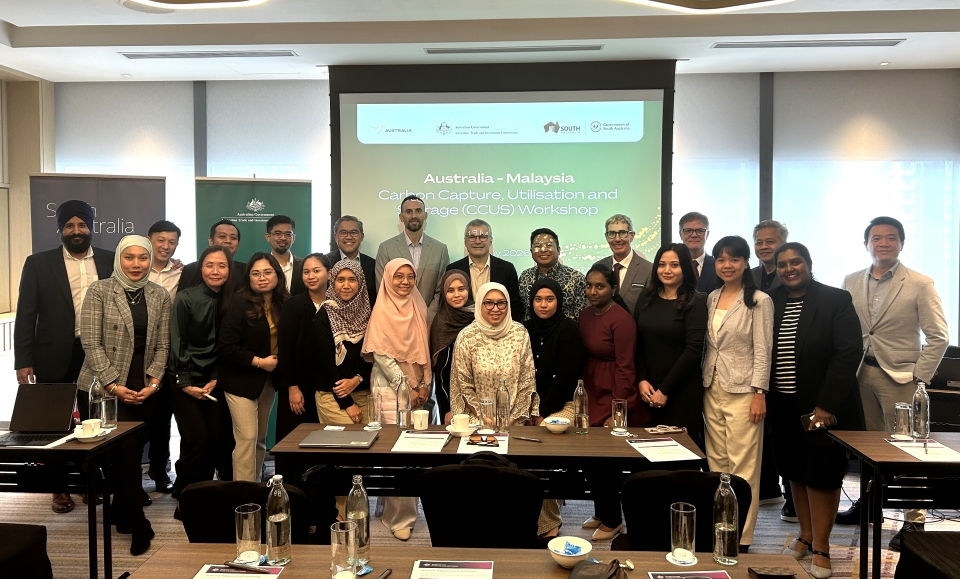
Stakeholders from government and industry learnt about Australia’s CCUS capability at a recent workshop.
Australia’s CCUS experience
Australia’s deep experience in carbon management is complemented by significant geological storage potential, including offshore saline aquifers and depleted reservoirs. Decades of operating large-scale liquefied natural gas (LNG) facilities have also built strong capability in subsurface engineering and fluid injection.
As an early mover scaling up carbon management to meet its net zero by 2050 targets, Australia’s commercial track record includes large-scale deployments:
- Moomba CCS Project (South Australia): A massive onshore initiative in the Cooper Basin capable of safely storing up to 1.7 million tonnes of gas processing emissions annually.
- Gorgon CCS Project (Western Australia): One of the world’s largest integrated CCS initiatives, designed to inject CO2 into an offshore saline aquifer, mitigating roughly 100 million tonnes of emissions over its lifespan.
Opportunities for Australian companies
Malaysia’s push to become a regional carbon storage hub via its CCUS Act 2025 (Act 870) has been stalled by supply chain and structural bottlenecks. The market lacks scalable industrial capture technologies and an established federal storage permit licensing protocol. There is also regulatory misalignment between the Federal Government and the autonomous state of Sarawak, which is creating legal and cross-border carbon accounting uncertainties.
Australia can help address these issues by supplying proven point-of-source capture engineering and advanced monitoring (MMV) software. Australian consultancies can also draw on their federal–state regulatory experience to help Malaysia develop the framework needed to harmonise its dual-track licensing systems. This will de-risk the ecosystem and help unlock international investment.
The Malaysia CCUS Agency has suggested establishing an Australia–Malaysia CCS regulator network to improve engagement and share knowledge between the 2 countries. This in turn will strengthen cooperation on carbon management and energy transition priorities.
Sign up to receive the latest news and insights about Southeast Asia.
Go further, faster with Austrade
Austrade’s Go Global Toolkit helps you learn the export basics, find the right markets and understand market requirements.