For Australian businesses experiencing supply chain volatility and disruptions, visit the Go Global Toolkit for the latest updates and support available.
India is becoming a key market for Australian toolmaker ANCA. The Melbourne-based company makes high-precision grinding machines, and exports almost all production to manufacturing companies around the world.
Growth in India is shaping the future direction of the company. Its innovative re-sharpening products will help tool manufacturers overcome challenges in global supply chains. ANCA’s technology will also help Indian industry to on-shore manufacturing in communications and computer equipment.
‘We are expanding operations with a strong focus on Bengaluru as a second base to our office in Melbourne,’ says Raghavendra Koneri, Country Director, ANCA. ‘By improving tool-making capabilities in India, we are helping Indian companies compete globally in advanced industries.’
Australian pioneer in smart, tool-making engineering
ANCA was founded by 2 entrepreneurs – Pat McClusky and Pat Boland – in Melbourne in 1974. Their goal: to use computing technology to develop world-beating tool-manufacturing equipment.
Today, ANCA has become a global leader in tool-grinding technology. Its high-precision machines are used to manufacture, sharpen and recondition cutting tools. They are also used to make complex components for the aerospace and medical industries.
‘We employ around 1,000 people,’ says Koneri. ‘We export 99% of our products and have customers in 45 countries. We have offices in the UK, Germany, China, Thailand, India, Japan, Brazil and the US, but our global headquarters is still in Melbourne.
‘Our success is built on competitive advantage. We combine machines, software and automation solutions to create a unique client-centric service. This helps our clients minimise waste and increase their own productivity.’
Demand for top-grade toolmaking in India
For ANCA, India is clear target market for global expansion.
‘India is a rapidly industrialising nation with a skilled workforce and a growing demand for precision tooling,’ says Koneri. ‘Our machines tap into demand in India for world-class tool-making capabilities.’
ANCA has adopted a phased market-entry strategy over the past 2 decades.
The company’s first step was to partner with a local distributor. As demand grew, ANCA transitioned to a direct-presence model in 2012, establishing its own office and technical centre in Bengaluru.
‘With a permanent presence, we can maintain full control over service quality and customer engagement,’ says Koneri. ‘Today, we have a locally managed team in India that is fully integrated into global operations.’
An India-specific growth strategy
ANCA tailors marketing to suit its customer base.
‘Our brand strategy involves demonstrating thought leadership,’ says Koneri. ‘We have positioned ANCA as a trusted name in precision tool manufacturing in India.
‘In practical terms, this means holding seminars to explain how our machines work. We also provide technology demonstrations at our technology centre in Bengaluru.’
ANCA also has a strategic approach to recruitment.
‘We partner with academic institutions and participate in job fairs,’ says Koneri. ‘This approach enables us to build a skilled workforce. Top engineering talent supports growth and helps us to innovate in India.’
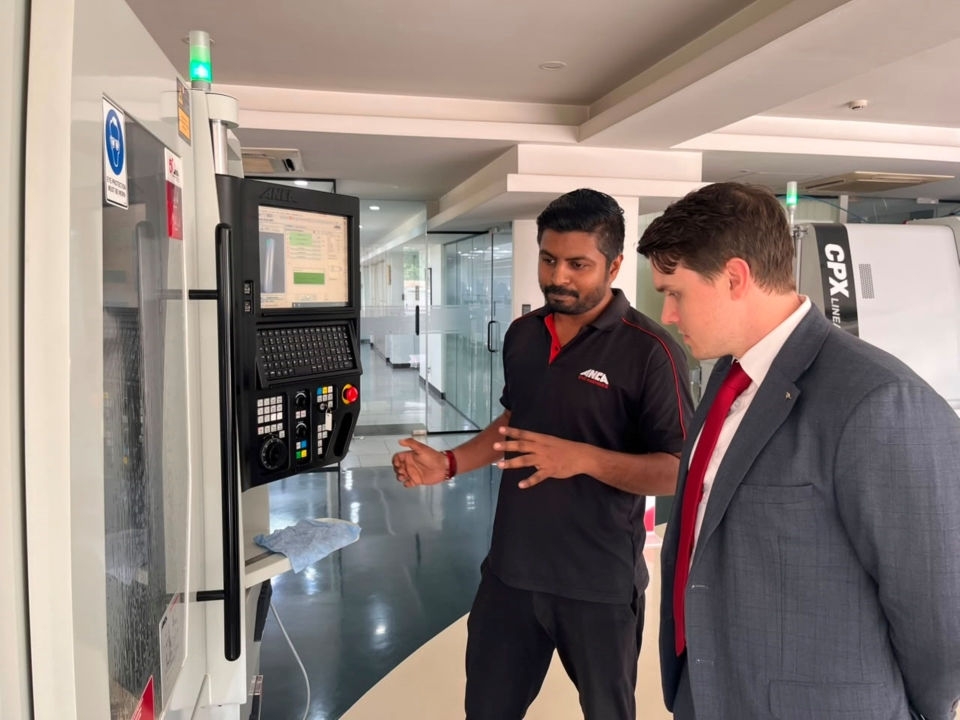
ANCA has a technical centre in Bengaluru to demonstrate how its technology works to customers.
New areas for growth
ANCA is adapting to new opportunities. India is now the second-largest market in the world for ‘3C’ goods – consumer electronics, and communications and computer equipment. Today, more than 800 million consumers have smartphones or are internet-connected.
ANCA’s machinery will help local manufacturers make more 3C goods in India.
‘We have deep experience in China, and we are now working to a similar model in India,’ says Koneri. ‘We can support the Indian Government’s push into electronics manufacturing. This is because our grinding software can cater to multiple markets.’
Diversification is critical in one specific area: re-manufacturing. Many of ANCA’s customers make machine tools from tungsten carbide. A global shortage of carbide mean prices have recently doubled, directly impacting customer margins.
‘Our equipment can be used to re-grind customers’ existing machine tools, and this process costs 30–40% of the price of new machinery,’ says Koneri. ‘We can help customers lengthen the lifecycle of their capital equipment, manage supply chain constraints and stay competitive.’
Austrade support in India
Austrade has worked with ANCA since 2021.
‘Austrade provides support wherever it is relevant,’ says Koneri. ‘This year, we will receive targeted, in-market support as part of Austrade’s focus on advanced manufacturing ecosystems.’
A successful India growth strategy
Since establishing a direct presence in 2012, ANCA has increased market share and improved customer satisfaction.
‘We have achieved a positive return on investment, driven by revenue growth and local cost control,’ says Koneri. ‘Our clients want to compete in highly sophisticated global markets. This includes making aerospace and medical equipment.’
ANCA initiatives are also helping raise skill levels in India.
‘We hold a tool-making competition, which attracts entries from leading tool manufacturers,’ says Koneri. ‘In 2025, we introduced a “Female Mechanist Award” to promote diversity and inclusion in India’s machining industry.’
Advice for exporters
Koneri has the following advice for exporters considering diversifying to India.
1. Technology alone is never enough. Emerging markets demand patience, trust-building and a service-first approach.
2. India’s scale and complexity will shape your global strategy. Our operations in India reinforce the importance of adapting to local culture and after-sales excellence.
3. Diversify and develop a competitive edge. Adaptability will help you meet customer challenges and outperform in terms of customer service.
Go further, faster with Austrade
Austrade’s Go Global Toolkit helps you learn the export basics, find the right markets and understand market requirements.