For Australian businesses experiencing supply chain volatility and disruptions, visit the Go Global Toolkit for the latest updates and support available.
South Asia’s growing middle class, changing consumer tastes and rapidly expanding e-commerce sector are creating new opportunities for Australian food and agriculture exporters.
During Austrade’s recent South Asia Roadshow series, these opportunities were firmly in focus. Supported by the Accessing New Markets Initiative (ANMI), the roadshows connected Austrade’s in-market expertise with Australian businesses, industry bodies, state governments and Trade Diversification Network (TDN) partners.
Mumbai-based Trade and Investment Commissioner Todd Miller shares his insights on what’s driving demand, the rise of e-commerce, and why relationship building is key to success.
The drivers of demands for agrifood in South Asia
One of the biggest factors we’re seeing in India is the growth of the middle class. They have exposure to foreign brands and services, and the means to buy quality products.
This is the generation whose parents worked extremely hard to put their children through university, including in Australia. When they return to India, they’re looking for a broader range of food, products and experiences than might previously have been available, such as organic products, health foods and sports supplements.
That’s happening alongside India’s greater exposure to international consumer trends more broadly. There’s a lot of competition in this market, including strong domestic producers, but the consumer base for premium international products is growing.
I think there’s also a recognition that the quality of Australian agricultural products is exceptional. Our image is clean and green and whether it’s meat, wine, packaged food or fruits and nuts, Australian producers are well-known for their quality and consistency of supply. Australia’s complementary growing season also fills supply gaps in India, ensuring peak demand for Australian produce when local crops are out of season.
The advantage of starting in a smaller South Asian market
South Asia isn’t a single market. India offers enormous scale, but when you look closer it’s less one single market than a collection of smaller complex markets, with diverse cultures, languages and regulatory environments.
Depending on the product and the opportunity, there can be advantages to starting in a smaller South Asian market, establishing relationships and learning how to operate in the region before taking on India.
Bangladesh is a good example. We recently took a joint Australian wool and cotton delegation there, giving businesses an opportunity to engage directly with textile manufacturers and understand the market.
Sri Lanka has also proved a valuable market for Australian exporters looking to establish a foothold in South Asia. Demand for Australian beef and packaged foods has been steadily growing, while premium, value-added products such as Victorian-made, pre-cooked duck meals, are also finding success. As the region’s rising protein consumption creates new opportunities for Australian meat and poultry producers, Sri Lanka is a strategic market to enter and test the region.
Smaller South Asian markets can offer significant commercial opportunities. But they can also give businesses a chance to test their proposition, understand local requirements and build regional experience.
Trade and Investment Commissioner Todd Miller shares insights about the South Asia region.
The importance of relationship building in India
India is a relationship market. It’s about investing time – both personally and as a company – and being prepared to come here, meet your partner, customer or importer and continue building that relationship.
Australian business culture can be quite transactional. But India is a long game; it may take several visits and meetings before you reach a deal. There can also be a perception that Indian customers are purely price-conscious when making purchasing decisions, but that isn’t what I’m seeing. Negotiations can be tough, but they’re about reaching an outcome where both parties feel they have worked hard and achieved something.
Businesses also need to understand the regulatory environment. Requirements vary considerably by subsector. Alcohol, for example, can be complex because businesses need to navigate both federal and state requirements, while product registration can be time-consuming and administratively intensive.
The opportunity is here and the market is enormous, but patience and time are essential.
The five-year trends to watch
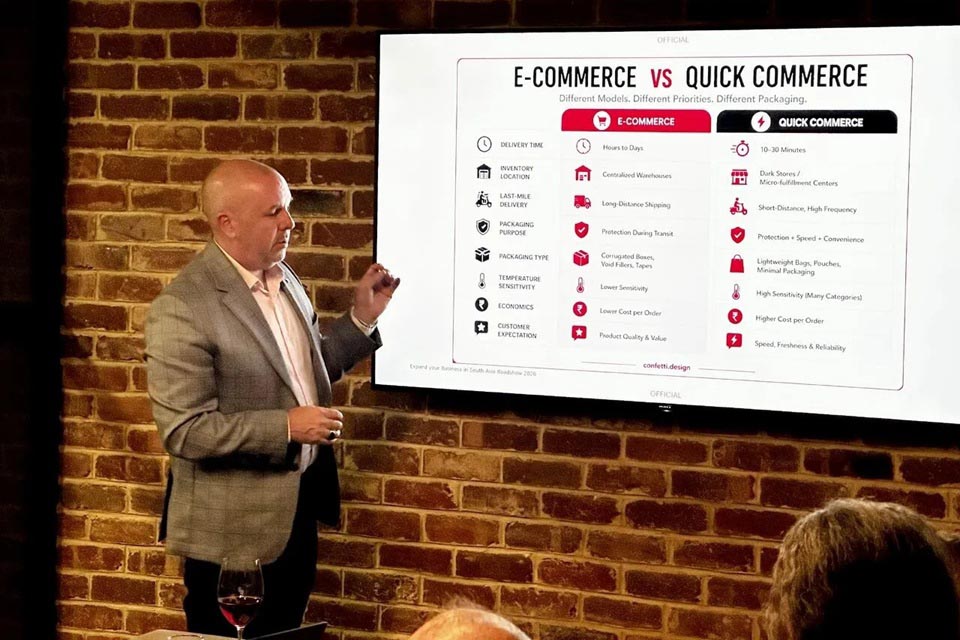
E-commerce – and particularly quick commerce – is a major one. Online purchasing isn’t confined to luxury consumers. The average Indian consumer is increasingly comfortable ordering a huge range of everyday products online, so these channels are becoming an important way of reaching customers.
We’re also watching growth at the higher end of the middle-class and into the emerging premium consumer segment. Even a relatively small proportion of India’s population represents an enormous number of consumers, and that segment aligns well with the premium positioning of many Australian products.
Wine is another interesting example. Australia already has a strong position in India’s imported wine market and consumption is continuing to grow, albeit from a relatively modest base. India remains overwhelmingly a whisky market, but there is movement in wine and that creates opportunities.
The important thing is to keep India’s scale in perspective. A niche here can still represent a very substantial market.
It’s also worth remembering the breadth of India’s opportunity for Australian exporters. Emerging industries are gaining traction. Interest in Australian hides, skins and leather has increased significantly, with a maiden Australian Hide Skin and Leather Exporters Association delegation to India earlier this year generating strong export outcomes.
For the larger Australian export community, the opportunities in India span a diverse range of agricultural and food-related sectors, while the scale of the market offers substantial growth potential over the long term.
Government and industry support for exporters
Funding from ANMI allowed Austrade, state government and TDN partners to expand the scope of the roadshow to more cities and sectors – reaching more businesses and giving them market insights they wouldn’t get anywhere else.
We spent months working together ahead of the Roadshow – recruiting businesses, developing the content and helping members understand what they would encounter in this market. We had strong support from TDN members Australian Cotton Shippers Association, Australian Food & Grocery Council, Australian Grape and Wine, Australian Organic, Grains Australia, Grain Trade Australia, Infant Nutrition Council and WoolProducers Australia.
State governments also leaned in strongly. In South Australia, for example, we had significant involvement from the TradeStart network. Advisers supported recruitment, participated in workshops and joined meetings with businesses.
What I think the TDN does particularly well is bring us together around a stronger “Why Australia?” story. It allows government and industry to present a more coherent Australian proposition, not only in India and South Asia but across global markets.
For more information on agrifood opportunities in South Asia, contact Austrade.
Go further, faster with Austrade
Austrade’s Go Global Toolkit helps you learn the export basics, find the right markets and understand market requirements.