For Australian businesses experiencing supply chain volatility and disruptions, visit the Go Global Toolkit for the latest updates and support available.
Founded in 2009, TracWater builds robots that monitor water quality in real time using an array of sensors. Measurements are taken autonomously every 5 minutes and uploaded to a cloud platform, highlighting changes and tracking water quality.
The robots are small, hard-wearing and battery-powered, operating in tight spaces and harsh conditions.
‘Our robots work in some pretty difficult places, where other types of sensors and monitoring equipment just don’t function,’ explains TracWater Managing Director Len McKelvey.
That includes remote sites in Australia and the Philippines, and locations in Singapore and Thailand.
Now, these robots are entering water systems in India — even though, according to McKelvey, that wasn’t originally on the agenda for 2026.
It was an invitation from Austrade that convinced him and co-founder Phil Hubble to explore the market. Now, they’ve incorporated a whole new business, headquartered in Chennai.
Business mission uncovers opportunities
The TracWater team travelled to India in October 2025, as part of Austrade’s inaugural Australian Water Delegation.
The one-week mission, across Mumbai and Chennai, connected Australian businesses in the water sector with Indian utilities, networks, government officials and experts. The companies also exhibited at the Australian Pavilion at IFAT, India’s largest trade fair for water, sewage, solid waste, and recycling.
‘We felt the mission would be a good measure of whether or not we should deploy resources in India,’ McKelvey says. ‘Those few days opened our eyes to some pretty important initiatives.’
Equally, he says, the meetings and connections facilitated by Austrade gave him a knowledge base that would usually take multiple research trips, and more.
‘I was able to gather facts and figures that wouldn’t normally be available,’ says McKelvey. ‘This is not the kind of researchable information you can get easily. For me, that was invaluable.’
Cooperative partnerships deliver true technology exchange
By January 2026, TracWater India was officially incorporated, and licensing technology from TracWater Australia. Less than 6 months later, it has its first proof-of-concept underway in India, plus a number of other projects in the pipeline.
In Australia and India alike, TracWater operates through cooperative partnership agreements, with water-quality robots deployed as Infrastructure-as-a-Service (IaaS).
This means the TracWater technology can be rolled out quickly, without significant upfront spend, and long budget lead times.
In India, it also means TracWater solutions can be developed in partnership with water utilities, leading to tailored, localised solutions.
‘If we’re going to do business under the commercial and contracting laws that apply in India, then we need to have an Indian entity able to undertake the technology transfer correctly,’ McKelvey explains.
‘It’s a different way of bringing Australian technology to India,’ he adds. ‘We didn’t want to be just another company trying to sell here. We want to achieve real technology interchange.’
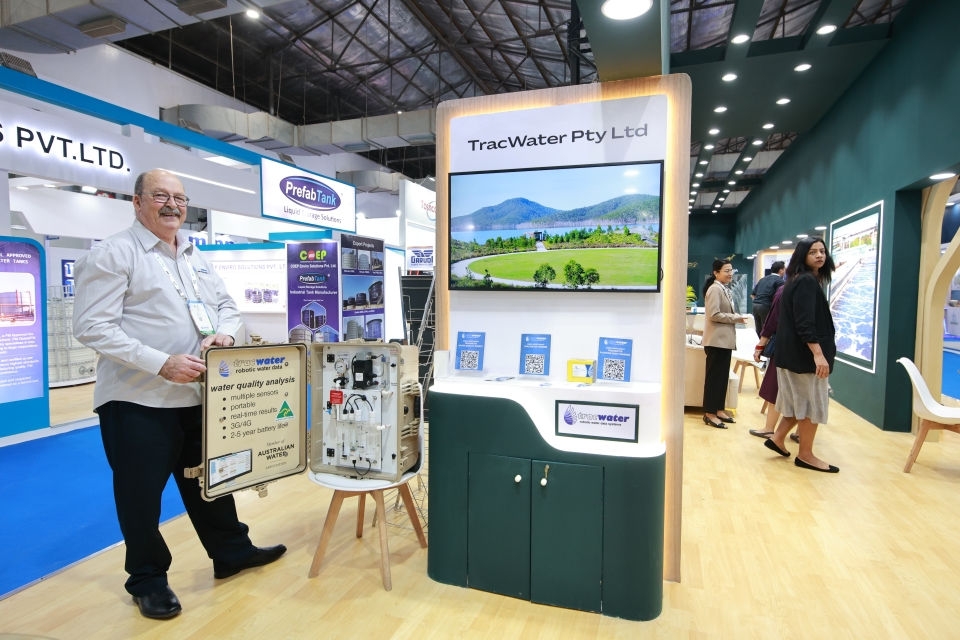
TracWater Managing Director Len McKelvey showcasing the company’s technology at the Australian Pavilion at IFAT.
Australian water innovation aligned with Indian needs
It’s perhaps no surprise that Indian authorities would look to Australia for water monitoring and management technology.
As a large and dry continent, Australia has a rich history of water innovation, whether that’s in conservation, treatment, recycling or monitoring.
In India, access to water is an increasingly pressing challenge. The nation is home to about 18% of the global population, but has just 4% of global freshwater. A growing population means water is becoming scarcer, with demand expected to be twice the available supply by 2030.
Reducing water loss and recycling water have been identified as critical areas for improvement by the Indian Government. For both, accurate monitoring will be essential.
‘Any technology that can reduce the loss of water, and reduce health risks from water-borne diseases … that’s a huge focus for local governments,’ McKelvey says.
At the same time, he sees India almost as a test market, showing what’s achievable in other markets experiencing severe water stress.
‘If we get India right, it’s a rubber stamp,’ says McKelvey. ‘If it works here, it will work anywhere else in the world.’
Export advice for SMEs
While it’s happened fast, TracWater’s launch in India hasn’t been without its challenges. Geopolitical instability has affected shipping, for example, with new restrictions making it practically impossible to get custom batteries shipped from Queensland to India.
Ultimately, the TracWater team was able to find a local partner to manufacture its specialised batteries in India — a positive outcome, albeit an unplanned one.
‘Global events come into play here,’ says McKelvey. ‘These are the kinds of logistical issues people may not think about until they actually receive an order or sign a contract.’
Even so, McKelvey sees exporting as an opportunity for smaller businesses like TracWater, as long as it’s the right market at the right time.
The key is in careful analysis, McKelvey says. That means clear alignment and market fit, plus ensuring you have the funds to cover the expansion, without expecting immediate returns.
‘Be clear in your objective; stay really focused,’ he advises.
‘It’s not going to come to you. You must go and get it. But Austrade can help smaller companies do that.’
Go further, faster with Austrade
Austrade’s Go Global Toolkit helps you learn the export basics, find the right markets and understand market requirements.